

Depuratore Ad Osmosi Inversa: Your Practical Guide to Pure Water
Are you wondering what is really in your tap water? Maybe you are tired of the constant battle with limescale buildup in your kettle and coffee machine. If so, a depuratore ad osmosi inversa (reverse osmosis purifier) might be the solution you need. It is a highly effective filtration system that gives you incredibly pure drinking water from your own kitchen tap. This guide explains how they work and what to consider.
Quick Answer: A reverse osmosis (RO) water purifier uses a semipermeable membrane to help reduce unwanted molecules and larger particles. This process is designed to capture common contaminants like chlorine, limescale, and lead, leaving you with cleaner, better-tasting water from a dedicated tap. This system offers a high level of filtration for home use.
Why Choose a Reverse Osmosis Water Purifier?
Across Europe, many people want a trustworthy way to upgrade their home water quality. Our municipal water is treated, but it often carries substances that affect taste and smell. A faint taste of chlorine or the chalky residue from hard water are common issues. A reverse osmosis system is built to solve these problems.
Think of it as the final line of defence for your family's drinking water, installed where you use it most. It offers a level of certainty that standard tap water cannot match.
Solving Common Tap Water Problems
An RO system is more than a simple filter. While basic pitcher filters might reduce chlorine, a depuratore ad osmosi inversa uses a multi-stage process to tackle a much wider range of unwanted substances.
Here is a quick look at what these systems are designed to capture:
- Taste and Odour: It helps get rid of the chlorine taste and other chemical smells, making your water crisp and refreshing.
- Limescale: By significantly reducing calcium and magnesium—the minerals that cause hard water—it helps protect your appliances from scale buildup.
- Heavy Metals: It helps filter out potentially harmful contaminants like lead, mercury, and arsenic, which can sometimes enter from older pipes.
- Dissolved Solids: It is designed to capture a high percentage of Total Dissolved Solids (TDS), which includes salts and other minerals, resulting in exceptionally pure water.
Installing a system under your sink provides a dedicated source of purified water. This is perfect for drinking, cooking, and making coffee or tea. Not only does everything taste better, but you will also buy fewer single-use plastic bottles.
If you would like to explore this topic further, you can learn more about what to look for in drinking water in our guide.
How a Depuratore Ad Osmosi Inversa Works
At its core, a depuratore ad osmosi inversa works like a high-tech sieve for your water. Imagine a security guard who only lets pure water molecules pass through. Almost everything else—unwanted contaminants and dissolved solids—is turned away. That is the simple idea behind this powerful technology.
Your tap water goes on a multi-stage journey before it reaches your glass. Each stage has a specific job, working together to strip away impurities layer by layer.
This diagram gives you a quick look at the basic path your water takes—from the tap, through the filters, and into your glass.
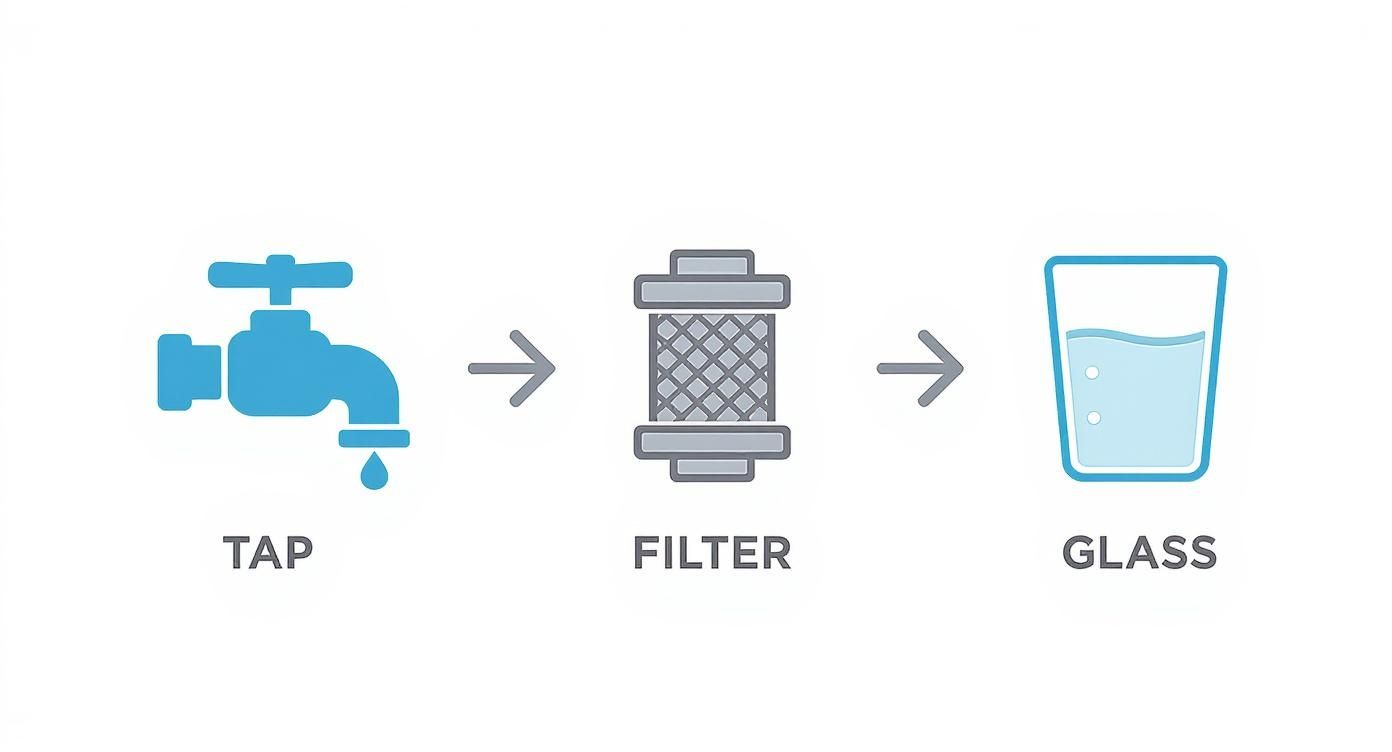
It’s a simplified view, but it shows how several steps work in sequence to achieve a high level of purity.
The Multi-Stage Filtration Process
Most reverse osmosis systems rely on a similar three-step purification sequence. This design protects the main RO membrane, ensuring it can do its job effectively for a long time.
-
Sediment Pre-Filter: This is the first line of defence. Its job is to catch larger particles like rust, sand, dirt, and silt. Removing these early prevents the more delicate filters from getting clogged. This helps maintain a good flow rate and extends the system's filter lifespan.
-
Activated Carbon Pre-Filter: Next, the water passes through an activated carbon filter. This stage acts like a magnet for chemical compounds. It is especially good at capturing chlorine, which is often used to treat municipal water. It also helps reduce other organic compounds and VOCs.
-
The Reverse Osmosis Membrane: This is the heart of the system. Here, water is pushed under pressure against a semipermeable membrane with microscopic pores. These pores are so tiny they block a wide range of contaminants while allowing pure water molecules to slip through to a storage tank.
What Happens to the Filtered Contaminants?
Where do all those trapped impurities go? This is where the idea of "wastewater" or "brine" comes in. As the system purifies your drinking water, the contaminants rejected by the membrane are washed away in a separate stream of water that goes down the drain.
This flushing action is crucial. It keeps the membrane clean and helps prevent build-up. While older models had a reputation for being wasteful, modern high-efficiency systems have improved. They are now designed to minimise the amount of water used in this cleaning process.
The effectiveness of reverse osmosis is impressive. The technology can achieve high rejection rates for dissolved solids. You can dig into the details on this technical data sheet to learn more about RO technology.
If you are looking for a solution for your bathroom, our collection of Shower Filters is designed to reduce chlorine and the effects of hard water on skin and hair.
Comparing Home Water Filtration Systems
Choosing the right water filter can feel complicated. There are many options, from simple jugs to advanced systems plumbed under your sink. To make the right choice, you need to understand what each type is designed to do.
A depuratore ad osmosi inversa is a top choice for pure drinking water, but that does not mean other filters are not useful. Let's break down the key differences in performance, cost, and maintenance.
Filtration Power
The biggest difference between filters is what they can pull out of your water. A basic filter jug or a simple device that screws onto your tap mainly improves taste and smell. They usually rely on an activated carbon filter, which does a good job of tackling chlorine.
A multi-stage reverse osmosis system is in a different league. Its specialised membrane is so fine that it captures a huge range of contaminants that other filters cannot touch. These include heavy metals and dissolved solids that create limescale.
- Pitcher & Faucet Filters: These are good for reducing chlorine and some odours.
- Shower Filters: Their main job is to help neutralise chlorine and hard water minerals.
- Reverse Osmosis Systems: These are the heavy hitters. They drastically reduce a wide spectrum of substances.
Cost and Long-Term Maintenance
The initial price is one thing, but long-term cost tells the whole story. Filter jugs seem cheap at first, but replacement cartridge costs add up. You might swap them every month or two.
A reverse osmosis system requires a bigger investment upfront, but its filters have a much longer filter lifespan. The pre-filters typically need changing every 6-12 months, while the core RO membrane can last for 2-4 years. Over time, this is often more economical than buying bottled water. You can learn more in our detailed breakdown of different faucet filters.
Home Water Filtration Options at a Glance
Here is a quick comparison of common home filtration systems. This table lays out the features, costs, and effectiveness to help you see how they stack up. Compare options with our quick table.
| Filtration Type | Primary Use | Key Contaminants Reduced | Typical Cost (€) | Maintenance Needs |
|---|---|---|---|---|
| Reverse Osmosis System | Ultimate drinking water purification at the tap. | Heavy metals, chlorine, limescale, dissolved solids. | €250 – €600+ | Pre-filters every 6-12 months; membrane every 2-4 years. |
| Faucet-Mounted Filter | Convenient filtered water for drinking and cooking. | Primarily chlorine and some sediment. | €30 – €70 | Cartridge replacement every 2-3 months. |
| Pitcher Filter | Basic filtering for small amounts of drinking water. | Chlorine taste and odour. | €20 – €50 | Cartridge replacement every 1-2 months. |
| Shower Filter | Reduces chlorine and hard water effects for bathing. | Chlorine, limescale minerals, some sediment. | €30 – €60 | Cartridge replacement every 4-6 months. |
While simpler filters are perfect for specific jobs, a reverse osmosis system is one of the best you can get for your drinking water.
Your Guide to Installing and Maintaining an RO System
Thinking about getting a depuratore ad osmosi inversa? The idea of installing one might seem daunting, but most modern kits are designed for a straightforward DIY setup. This guide will walk you through setting up and looking after your system.
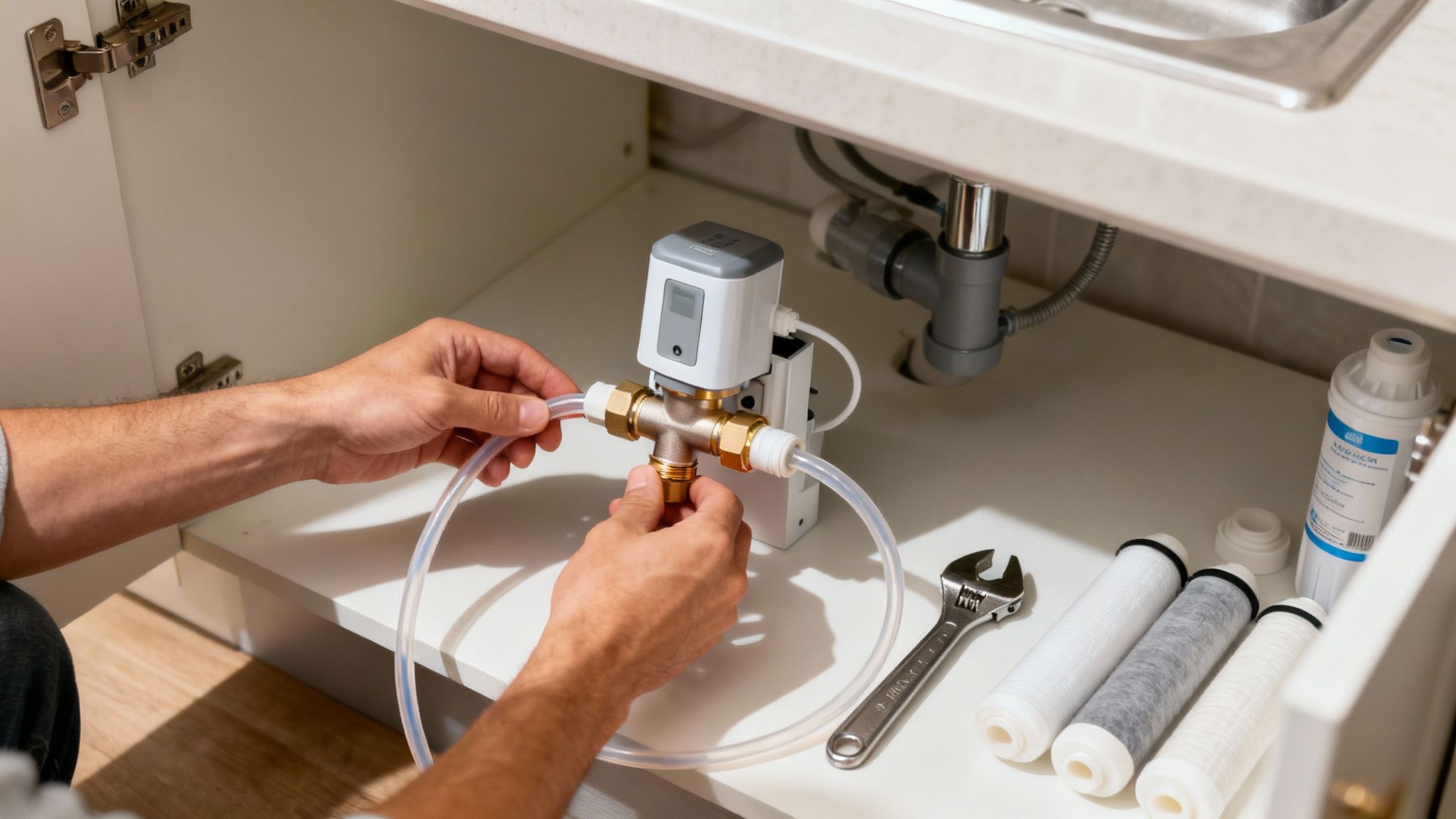
Of course, if you're not comfortable doing it yourself, calling a professional plumber is always a solid choice.
A DIY Installation Checklist
Most reverse osmosis kits are built to fit neatly under the kitchen sink and include everything you need. While every model is slightly different, the general process looks something like this.
- Turn Off the Water: First, always shut off the cold water supply valve under your sink.
- Install the Dedicated Faucet: Your RO system will come with its own smaller faucet. This often means drilling a new hole in your countertop or sink area.
- Connect the Water Supply: You will use an adapter valve to tap into your cold water line.
- Position the Filters and Tank: Find a good spot under the sink for the filter assembly and the storage tank.
- Connect the Tubing: This part is usually colour-coded. You will connect tubes between the supply line, filters, tank, new faucet, and drain.
- Check for Leaks and Flush: Slowly turn the water back on. Carefully check every connection. Then, follow the instructions to flush the system.
Many under-sink water filter systems are designed for easy installation. You can explore our guide on the miglior depuratore acqua sottolavello to see how different models compare.
Keeping Your System in Top Shape
To ensure your RO system keeps working effectively and maintains a good flow rate, regular maintenance is key. The most important job is changing the filters and membrane on schedule. If you delay, the system will not purify as well.
Your Filter Replacement Schedule
How long your filters last depends on your local water quality and how much water you use. However, there is a general schedule you can follow.
- Sediment and Carbon Pre-Filters: These catch bigger particles and chlorine. They usually need replacing every 6 to 12 months.
- RO Membrane: The reverse osmosis membrane has a filter lifespan of about 2 to 4 years.
- Post-Filter: Many systems have a final carbon filter to polish the taste. This is typically changed every 12 months.
When it’s time for a change, you can find what you need in our collection of Refills & Cartridges. Check sizes & refills — fast EU shipping.
Costs and Environmental Impact
When considering a depuratore ad osmosi inversa, it is smart to look beyond the initial price tag. The true cost includes the system, replacement filters, and a small potential increase in your water bill.
Breaking Down the Total Cost of Ownership
A good under-sink reverse osmosis system typically costs between €250 and over €600. This depends on the brand, features, and efficiency. Think of it as a long-term investment.
After installation, your main recurring expense will be for filters. The pre-filters, which catch sediment and chlorine, usually need swapping every 6 to 12 months. The RO membrane itself lasts for 2 to 4 years. You can learn more in our guide on improving drinking water quality.
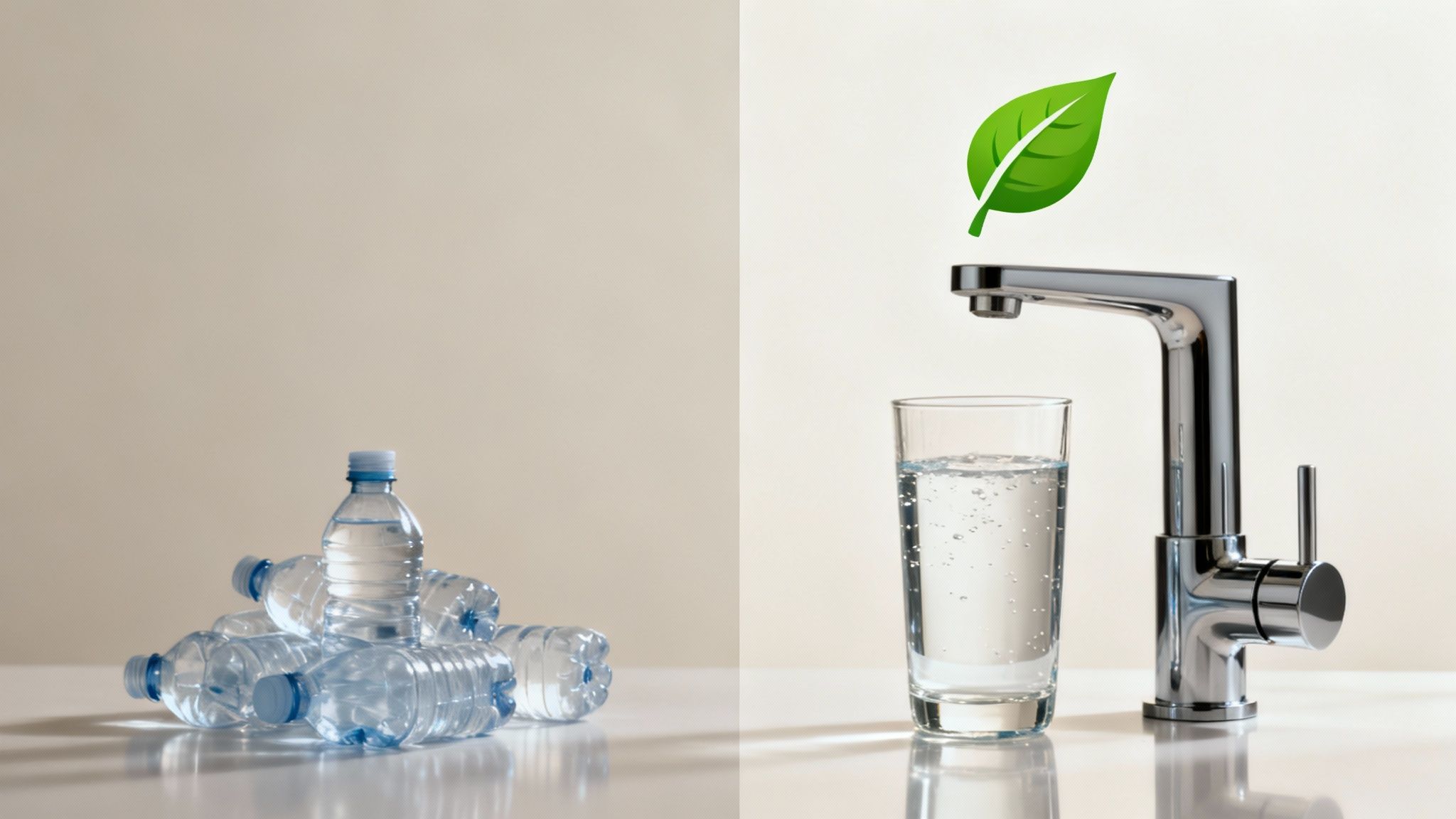
When you compare it to the cost of buying bottled water, an RO system often pays for itself in a few years. You will also dramatically reduce your household’s single-use plastic waste.
The Environmental Footprint
The reverse osmosis process splits your tap water into two streams: one with pure, filtered water and another with the removed contaminants. This concentrated stream, called brine, is flushed away.
Older systems could be wasteful, but technology has improved. Modern, high-efficiency models are designed to be smarter with water. Some units have impressive ratios, producing only one litre of wastewater for every litre of pure water.
- Wastewater (Brine): This is the system's self-cleaning mechanism. It is essential for flushing away contaminants.
- Efficiency Ratios: Look for systems with low waste-to-pure-water ratios. A 2:1 or even a 1:1 ratio is a great sign.
- Plastic Reduction: The biggest environmental win is the drastic cut in plastic bottle use, which significantly shrinks your carbon footprint.
By choosing a modern, efficient depuratore ad osmosi inversa, you get both incredible water purity and a more responsible way to use resources.
Creating a Healthier Home Environment
Choosing a depuratore ad osmosi inversa is a great first step, but it is just one part of creating a truly healthy home. Pure drinking water is the foundation, but the quality of your shower water and the air you breathe also impact your well-being.
Beyond Drinking Water: A Holistic View
While your RO system provides excellent drinking water, your bathroom tap water may still contain chlorine and hard water minerals. These can strip natural oils from your skin and hair, leaving them dry.
Installing one of our Shower Filters is a simple way to address this. They are designed to reduce chlorine, helping protect your skin and hair. See the Shower Filters kit that installs in minutes.
Similarly, indoor air can be full of invisible particles. Dust, pollen, and volatile organic compounds (VOCs) are common. Our Air Purifiers use advanced HEPA filtration to capture micro-particles like PM2.5, helping to create fresher, cleaner air.
An Integrated Approach to Home Wellness
Combining these solutions creates a synergistic effect. This integrated strategy helps you build a sanctuary of well-being.
- Pure Water for Drinking: An RO system provides the cleanest possible water for consumption.
- Softer Water for Washing: A shower filter helps reduce the drying effects of chlorine on skin and hair.
- Cleaner Air to Breathe: An air purifier captures airborne allergens and irritants.
This technology is powerful. In Italy, reverse osmosis is vital in industrial wastewater recovery, with plants reaching recovery rates up to 95%. This high efficiency reduces water consumption and environmental impact. You can find more insights on Italian wastewater treatment systems at watertreatmentmagazine.com.
By thinking about your home as a whole, you are building a consistently healthier environment. If you want to learn more about shower filtration, you might find our guide on how to choose a shower filter for hard water helpful.
Disclaimer: Home filtration complements—not replaces—professional advice. For specific water quality issues, always consult a qualified expert.
Frequently Asked Questions
Let's tackle some of the most common questions about a depuratore ad osmosi inversa.
Does Reverse Osmosis Remove Healthy Minerals?
Yes, it does. The reverse osmosis membrane is so fine that it cannot tell the difference between a contaminant and a beneficial mineral like calcium or magnesium—it reduces both.
However, we get most of our essential minerals from food, not water. For those who prefer the taste, many modern RO systems come with a remineralisation filter. This final stage adds a small, balanced amount of healthy minerals back into the water, which often improves the flavour.
How Much Water Does an RO System Waste?
This depends on the efficiency of the unit you choose. Older models were known for being wasteful.
Modern, high-efficiency systems are built to conserve water. It is now common to see waste-to-pure-water ratios as low as 2:1 or even 1:1. When shopping, pay close attention to the system's efficiency rating.
How Often Do I Need to Change the Filters?
How long your filters last depends on your local tap water and how much water your family uses. There is a standard schedule you can follow.
- Pre-filters: These catch sediment and chlorine. Plan on replacing them every 6–12 months.
- RO Membrane: This is the heart of the system and should last 2–4 years.
- Post-filter: The final polishing filter usually needs swapping once a year.
Keeping up with this schedule is key. It ensures your water stays pure and maintains a good flow rate.
Can I Install an RO System Myself?
Yes. Most under-sink reverse osmosis systems are designed for DIY installation. They typically come as a complete kit with clear instructions and colour-coded tubing.
If you are comfortable with basic plumbing tasks, you can likely set it up in an afternoon. But if you are not confident, calling a professional is always an option. A plumber will ensure everything is installed correctly and leak-free.
At Modern Essentials, we believe everyone deserves cleaner, better-tasting water. Our Shipping Policy outlines our fast EU delivery. Explore our Knowledge Hub for more guides.
See the Water Filters kit that installs in minutes.