

Under-Sink Water Purifiers (Depuratori Acqua Sottolavello): The Practical Guide
An under-sink water purifier is a compact system that installs directly beneath your kitchen sink. It connects to the cold water line to give you a steady stream of filtered water whenever you need it, right from its own dedicated tap. It is a practical solution that improves the taste and quality of your water without cluttering your worktop.
Quick Answer: An under-sink water purifier (depuratori acqua sottolavello) is a multi-stage filter system installed in the cabinet under your kitchen sink. It connects to your cold water line to help reduce common impurities like chlorine and sediment, improving the taste and smell of your tap water directly at the source.
Why Choose an Under-Sink Water Purifier?
Filtering your home’s water is a smart move for better-tasting drinks and healthier habits. For many European households, an under-sink purifier offers the perfect balance of performance and convenience, making it a popular kitchen upgrade. Unlike other options, it works silently and out of sight.
This guide will walk you through everything you need to know about these systems. We will explore how they work, compare them to other filter types, and provide a simple checklist to help you choose the right one for your home.
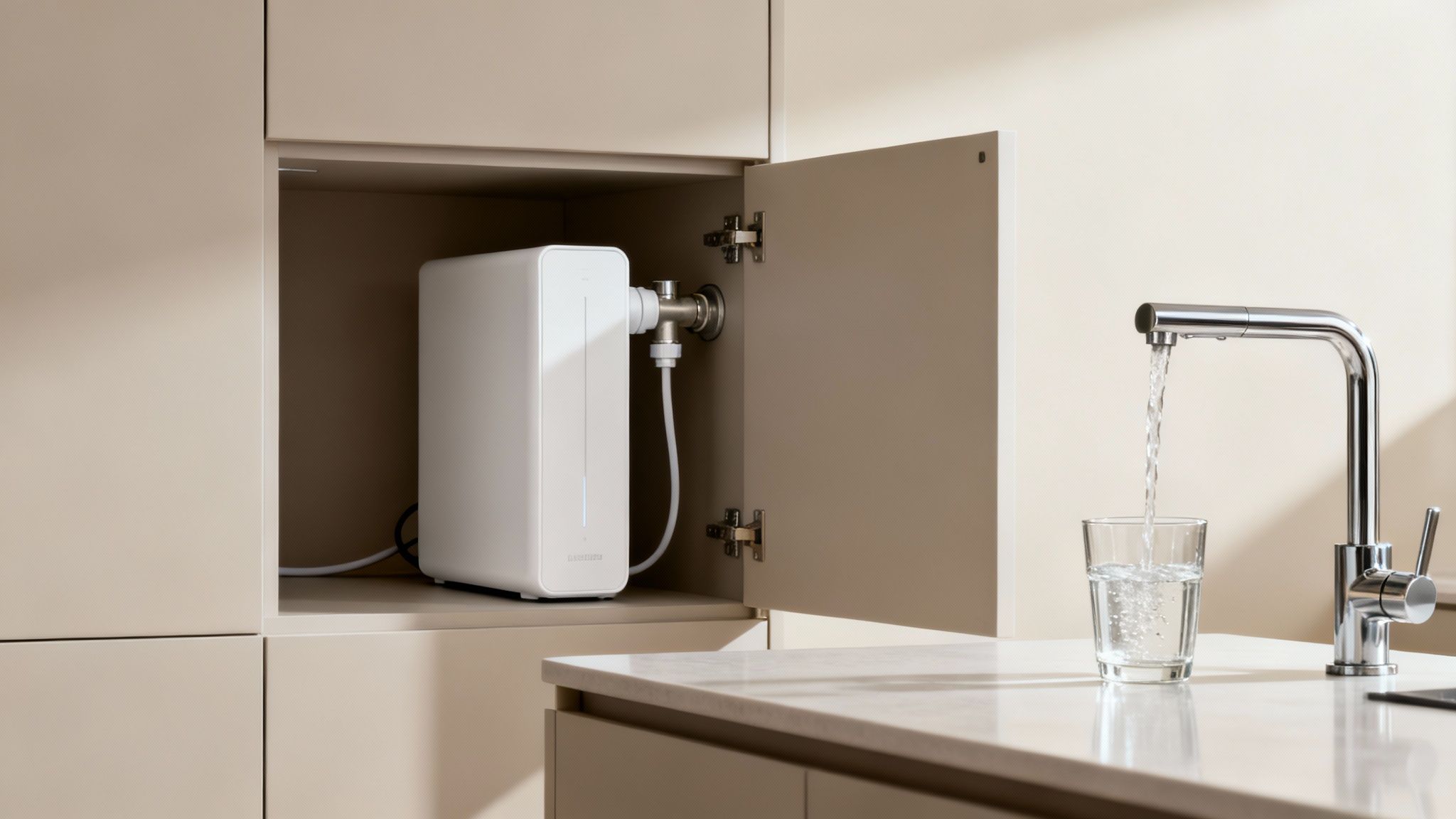
Key Benefits for Your Home
An under-sink system offers several advantages that make a real difference in daily life. It is designed to tackle common water quality issues right at the point of use. You can learn more in our detailed guide on drinking water purification.
Here are the main benefits:
- Superior Filtration: Multi-stage filters are designed to capture a wider range of substances than simple filter pitchers, including chlorine and sediment.
- Constant Convenience: Get fresh, filtered water instantly. There is no need to refill a jug or wait for water to slowly drip through a filter.
- Space-Saving Design: The entire system is hidden away, keeping your kitchen worktops clear and tidy for a clean, modern look.
- Cost-Effective & Sustainable: By filtering your tap water, you can drastically reduce your reliance on single-use plastic bottles, saving money and reducing your environmental impact.
Ultimately, installing an under-sink water purifier is a small change that delivers consistent, high-quality results day after day.
Understanding Your Tap Water Quality
Ever wondered what is actually in the water coming from your tap? Across Europe, public water treatment is generally excellent. However, that water travels a long way through a vast network of pipes before it reaches your kitchen. On its journey, it can pick up things that change its taste, smell, and overall quality.
This is not about being alarmist; it is about being informed. When you understand the common issues, you see the value of adding a final protective barrier right where you fill your glass.
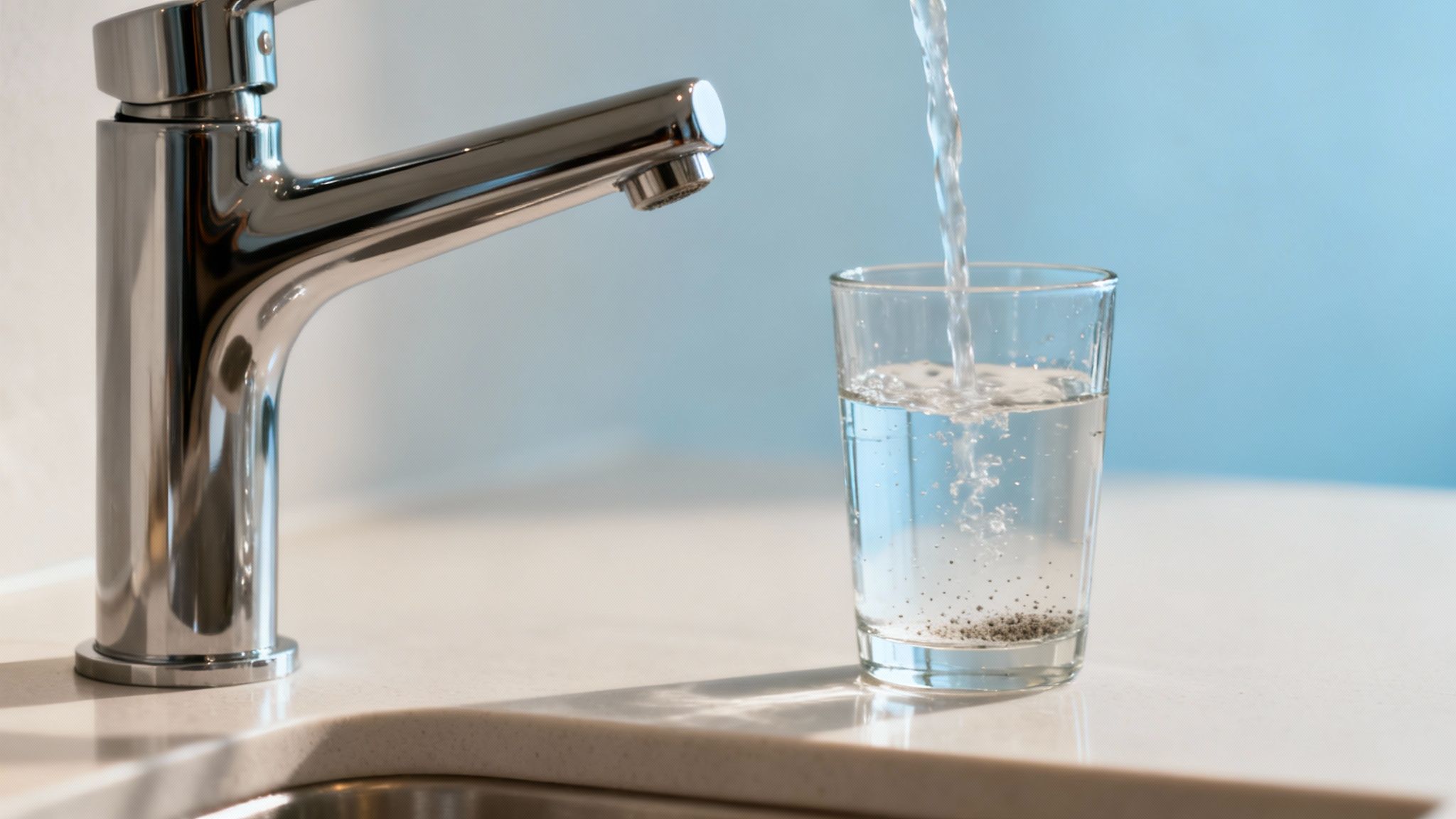
Common Tap Water Impurities
While your tap water is most likely safe, it often contains several substances that a good filter is designed to tackle. Knowing what they are helps you appreciate how a depuratori acqua sottolavello can improve your daily glass of water. For a deeper dive, check out our guide on whether tap water in Italy is safe to drink.
So, what are we usually dealing with?
- Chlorine: This is the standard disinfectant for public water supplies. It does a great job killing harmful bacteria, but it also gives water that "public pool" smell and taste that many find unpleasant.
- Limescale (Hardness): This is a build-up of dissolved minerals like calcium and magnesium. It is the cause of the chalky white marks on your kettle, coffee machine, and glasses. It can also affect the flavour of your tea or coffee.
- Sediment: As water flows through older pipes, it can pick up tiny particles of rust, sand, and dirt. This can make your water look cloudy or even feel slightly gritty.
- Trace Contaminants: On its long trip to your home, water can sometimes pick up trace amounts of other things, like organic compounds or residue from agricultural runoff.
An under-sink purifier acts as your last line of defence. It is a targeted solution that helps capture impurities picked up along the way. This ensures the water you drink and cook with is as pure and fresh as possible.
How Your Under-Sink Water Purifier Works
To understand how an under-sink water purifier transforms your tap water, think of it as a highly coordinated team. It is not one single filter doing all the work, but a multi-stage process where each component has a specific job. This teamwork is what makes under-sink systems so effective at improving your water's taste, smell, and purity.
The entire process happens instantly and out of sight. When you turn on the dedicated tap, cold water is diverted through the filtration unit hidden in the cabinet below. It passes through each stage in sequence before emerging clean and fresh. Let’s look at this journey step-by-step.
Stage 1: The Sediment Pre-Filter
The first specialist your water meets is the sediment pre-filter. Its role is simple but crucial: it acts as a gatekeeper. This filter has a porous physical barrier that stops larger particles from passing through.
It is designed to capture particles like:
- Rust flakes from older pipes
- Grains of sand and silt
- Other visible debris
By removing these coarser sediments first, the pre-filter clears the way for the next stages to work more effectively. This not only improves water clarity but also helps extend the filter lifespan of the more specialised filters that follow, preventing them from clogging too quickly.
Stage 2: The Activated Carbon Core
Next, the water flows into the heart of the system: the activated carbon filter. This is where the real magic happens for taste and odour. Think of activated carbon as a microscopic super-sponge. It has an incredibly large internal surface area packed with millions of tiny pores.
The surface area of just one gram of activated carbon can be equivalent to an entire football field. This massive area allows it to effectively capture a wide range of chemical impurities through a process called adsorption.
This stage is specifically designed to target:
- Chlorine: It effectively helps reduce the chemical taste and smell common in treated tap water.
- Volatile Organic Compounds (VOCs): These are various chemical compounds that can find their way into water sources.
- Other Taste and Odour Issues: It helps neutralise other unpleasant flavours, leaving your water tasting fresh and clean.
This two-step approach—first physical, then chemical—is what makes multi-stage filtration so powerful. Each stage builds on the last, ensuring a much more thorough purification than a simple single-cartridge system could achieve. For those interested in more advanced purification, you can read our guide on reverse osmosis systems. However, for everyday drinking water, multi-stage filtration offers a fantastic balance of performance and simplicity.
Comparing Water Filter Types for Your Home
Picking the right water filter can feel confusing. You have pitchers, tap attachments, countertop units, and under-sink purifiers. They all claim to give you cleaner water, but they work in very different ways and fit into your life differently. Let's break them down to see which one makes the most sense for you.
We will look at what matters most: filtration performance, convenience, installation, and long-term cost. While a simple filter pitcher has its uses, it comes with slow filtering and constant refilling. A depuratori acqua sottolavello, on the other hand, integrates into your kitchen plumbing for a steady stream of pure water on demand.
The Main Options in Home Water Filtration
When you start looking, you will find four main types of home water filters. Each one offers a different balance of performance, price, and practicality.
- Filter Pitchers: These are the most basic option. You fill the jug with tap water and wait for it to trickle through a small carbon filter. They are cheap to buy but only filter a small amount at a time.
- Faucet-Mounted Filters: These small devices screw directly onto your kitchen tap. A simple switch lets you choose between filtered and unfiltered water. They are easy to install but can slow your water flow and do not fit all tap styles.
- Countertop Filters: These systems sit next to your sink and connect to your tap with a tube. They generally filter better than pitchers or tap mounts, but they take up valuable counter space.
- Under-Sink Purifiers: Tucked away out of sight, these systems are plumbed directly into your cold water line. They use a separate, dedicated tap to deliver high-performance filtration, giving you both power and convenience.
This diagram shows the straightforward but effective two-stage process many under-sink purifiers use, starting with a sediment filter before moving to an activated carbon filter.

As you can see, each stage has a specific job, targeting different impurities to ensure a more thorough clean than you would get from a single-stage filter.
Comparing Filter Systems Side-by-Side
To understand the trade-offs, let's compare these options. The right choice depends on your priorities—whether that is top performance, convenience, or budget. If you want a deeper look at basic options, check our guide on the pros and cons of water filter pitchers.
The table below breaks down the key differences. Compare options with our quick table.
| Filter Type | Filtration Performance | Convenience & Flow Rate | Installation | Average Annual Cost (€) |
|---|---|---|---|---|
| Under-Sink Purifier | High: Multi-stage filters designed to capture chlorine, limescale, and sediment. | Excellent: Instant, high flow rate from a dedicated tap. No waiting. | Moderate: DIY-friendly kits install in under an hour with basic tools. | €50 – €100 |
| Filter Pitcher | Low: Basic activated carbon filter; slow gravity-fed process. | Low: Filters very slowly; needs constant refilling and takes up fridge space. | None: Ready to use out of the box. | €40 – €80 |
| Faucet-Mounted Filter | Low to Moderate: Small filter with limited capacity and filter lifespan. | Good: Instant switch between filtered/unfiltered water, but can reduce flow. | Easy: Screws onto most standard taps in minutes. | €30 – €60 |
| Countertop Filter | Moderate to High: Larger filters offer good performance. | Moderate: Connects to tap with a diverter valve; takes up counter space. | Easy: Simple hose connection to the existing faucet. | €60 – €120 |
While other filters can be a starting point, the depuratori acqua sottolavello finds the sweet spot. It delivers powerful filtration without cluttering your kitchen, making it a smart investment for any home.
Installation and Maintenance Made Simple
The thought of dealing with plumbing can seem intimidating, but modern depuratori acqua sottolavello are designed for easy DIY installation. Most people can complete the setup in less than an hour using basic tools.
Everything you need comes in the box. The job involves connecting the filter unit to your cold water line with a few simple, secure fittings. There are no permanent changes to your kitchen—just a simple upgrade that makes a big difference.
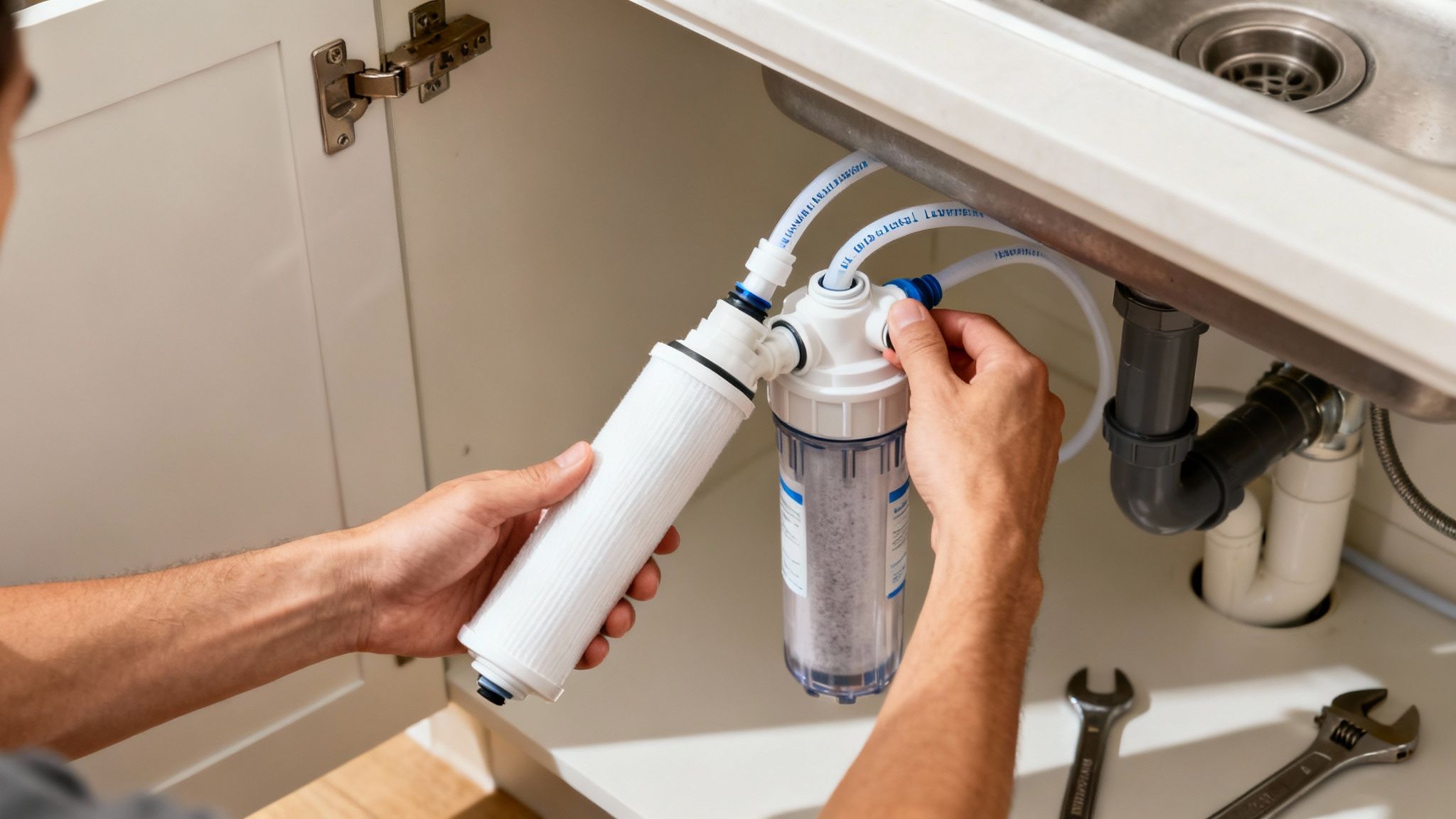
A Quick Look at Installation Steps
While every model is slightly different, the basic steps are nearly the same for any user-friendly system. The goal is to route your cold water through the filter before it reaches your new dedicated tap.
Here is what that usually looks like:
- Turn Off the Water: First, find the shut-off valve for the cold water under your sink and turn it off.
- Add the T-Adapter: Unscrew the flexible hose from the cold water valve. Screw on the T-adapter from your kit. This piece splits the water flow, creating a line for your filter without affecting your main tap.
- Mount the Filter: Find a convenient spot under the sink to hang the filter housing. A couple of screws into the cabinet wall is usually all it takes.
- Connect the Hoses: Now, connect the tubing. One hose goes from the T-adapter to the filter's "in" port, and another goes from the "out" port to your new filter tap. Most modern kits use push-to-connect fittings that seal tightly with a firm push.
- Check Your Work: Slowly turn the water back on and check every connection for drips.
Keeping Your System in Top Shape
Once your purifier is running, maintenance is very easy. Your only task is to replace the filter cartridges on schedule. No complicated parts to clean or technical checks are needed.
The typical filter lifespan is between 6 to 12 months, depending on your water usage and local water quality. Changing the cartridge is often as simple as twisting the old one off and twisting the new one on. Check sizes & refills — fast EU shipping.
Your Under-Sink Purifier Buying Checklist
Choosing the right depuratori acqua sottolavello does not have to be complicated. This simple checklist will guide you through everything from measuring your space to understanding performance metrics.
Think of this as your roadmap. It will help you focus on what really matters, ensuring you pick a system that fits your kitchen and addresses your specific water quality concerns.
Space and Plumbing
First, grab a tape measure. Under-sink purifiers are compact, but the space under a sink can be tight, especially with a waste disposal unit.
- Measure Your Space: Check the available height, width, and depth in your cabinet. Compare these dimensions to any purifier you are considering.
- Check Your Plumbing: Look at your cold water line. Most kits are designed for standard flexible hoses, but it is always good to double-check compatibility.
- Assess Your Sink: Do you have a spare hole for the new filter tap? Many sinks come with a knockout hole, often covered by a cap, which is perfect for this.
For advice on matching new hardware to your kitchen's style, see this guide on choosing kitchen and bath fixtures.
Filtration Performance and Maintenance
Next, think about what you want the filter to do. Different filters are designed to tackle different problems.
- Identify Your Main Concerns: What bothers you about your tap water? Is it the taste of chlorine? Are you tired of descaling your kettle due to limescale? Look for a system that states it helps reduce the specific contaminants you are worried about.
- Check the Filter Lifespan: How often will you need to change the cartridge? A typical filter lifespan is 6 to 12 months. A longer-lasting filter often means less hassle and lower running costs.
- Confirm Cartridge Availability: Make sure replacement cartridges are easy to find and order. Easy upkeep is key.
If you are also considering options that attach to your main tap, our article on the BRITA On Tap system offers a useful comparison.
Use this checklist to ensure you choose the right 'depuratori acqua sottolavello' for your home.
| Checklist Item | Why It Matters | Your Notes |
|---|---|---|
| Space Dimensions | You need to ensure the unit will physically fit under your sink without any issues. | |
| Plumbing Type | Confirming your cold water line is compatible makes for a smooth, DIY-friendly installation. | |
| Faucet Hole | Check if you have a spare hole in your sink or countertop for the dedicated filter tap. | |
| Key Contaminants | Match the filter's reduction capabilities (e.g., chlorine, limescale) to your specific needs. | |
| Filter Lifespan | A longer lifespan means less frequent changes and potentially lower long-term costs. | |
| Cartridge Cost | Factor in the price of replacement cartridges to understand the total cost of ownership. | |
| Ease of Installation | Look for systems designed for simple DIY setup to avoid hiring a plumber. | |
| Flow Rate | A good flow rate means you won't be waiting long to fill a glass or a pot. | |
| Certifications | Independent certifications provide third-party verification of performance claims. | |
| Brand Reputation | Choose a brand known for quality and good customer support for peace of mind. |
Frequently Asked Questions
Here are straightforward answers to the questions we hear most often about under-sink water purifiers.
How Can I Find Out What’s In My Local Water?
The best place to start is your local water utility provider. In the EU, most suppliers are required to publish annual water quality reports, which you can usually find on their websites. These reports break down test results for common minerals and additives like chlorine, giving you a clear baseline for your home’s water quality.
Will This Filter Lower My Water Pressure?
No. Modern under-sink systems are designed to have almost no impact on your water pressure. Since the filter connects to its own dedicated tap, the flow rate from your main kitchen tap remains exactly the same. The flow from the filter tap itself is engineered to be strong and steady.
Disclaimer: Home filtration complements—not replaces—professional advice. If you have specific health concerns about your water, it is always best to consult a qualified water quality specialist.
Are The Replacement Cartridges Sustainable?
Sustainability is important. The simple act of using an under-sink filter drastically cuts down on single-use plastic bottles, which is a significant environmental benefit. When choosing a system, look for brands that provide clear instructions on how to dispose of used cartridges. Some parts may be recyclable. You can find easy-to-install replacements in our Refills & Cartridges collection.
How Do I Know When To Change The Filter?
The recommended filter lifespan is your most reliable guide. For most systems, this means a quick swap every 6 to 12 months. A simple tip is to write the installation date on the new cartridge with a marker or set a reminder on your phone. Sticking to a schedule ensures your depuratori acqua sottolavello continues to perform perfectly.
Ready to enjoy consistently great-tasting water from your own tap? At Modern Essentials, we make it simple.
➡️ See the Water Filters kit that installs in minutes.