

A Practical Guide to Ricaricare Bombola Co2 Safely
When your CO2 cylinder runs dry, you have two safe options: get it refilled professionally or swap it for a new one. While you might see DIY refill kits online, handling high-pressure gas at home without proper equipment is extremely dangerous. This guide will help you choose the best, safest method.
Quick Answer: The safest ways to
ricaricare bombola co2are professional refill services or cylinder exchange programs. Refilling is often cheaper, while exchanges offer convenience. Never attempt to refill a cylinder yourself due to the high pressures involved. Always use certified food-grade CO2 for drinks or aquariums.
Understanding Your Refill and Exchange Options
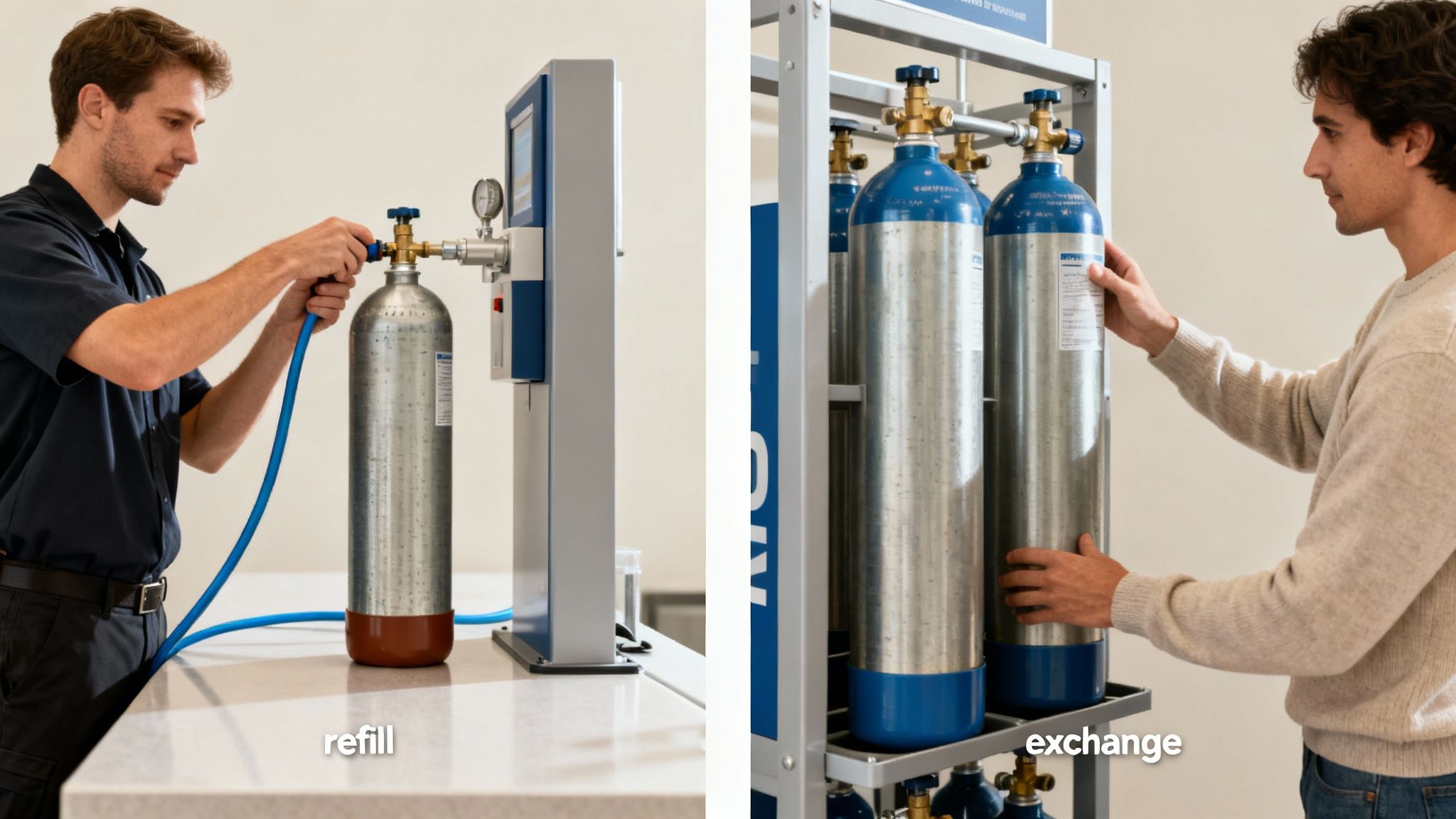
Before you get more CO2 for your soda maker or aquarium, it’s important to understand your choices. This isn’t just about finding the cheapest option; it’s about safety, convenience, and getting the right type of gas. Looking at the wider world of portable compressed gas tank solutions shows how seriously professionals take safety.
For home use, there are two reliable methods. Let's review them so you can decide what works best for you.
Professional Refill Services
This is the traditional approach. You take your empty cylinder to a specialised shop, and they fill it for you. These are places like welding gas suppliers or homebrew shops that have the right equipment to manage high-pressure gas. The main advantage is cost. You typically only pay for the gas, which is cheaper over time.
However, it requires a bit more effort. You have to find a local, certified service and take your cylinder to them. A good technician will also perform a quick safety check, looking at its condition and making sure it hasn't expired.
Cylinder Exchange Programs
If convenience is your top priority, exchange programs are a great choice. You bring your empty cylinder to a retailer, like a supermarket, and swap it for a full one. It’s a simple "full-for-empty" transaction that is quick and widely available.
This method may cost a bit more per fill, but it offers peace of mind. Every cylinder you get has been cleaned, inspected, and sealed by the manufacturer. This is the model that popular brands use.
Crucial Takeaway: Never try to refill a CO2 cylinder yourself. The process involves extreme pressures and temperature changes that require specific equipment. A mistake can be dangerous. Always leave it to professionals.
It's also vital to know your CO2. There are two main types:
- Food-Grade CO2: This is purified to a high standard. It is the only type you should use for carbonating drinks.
- Industrial CO2: This is used for welding or other industrial processes. It can contain impurities that are not safe to drink.
As a company focused on making home life safer and better, we believe in making smart choices. You can read more about our story and mission to see our commitment to quality. No matter where you go, always confirm your supplier uses food-grade CO2 if it is for drinks or your aquarium.
How to Ricaricare Bombola Co2: Refill or Exchange?
So, your CO2 cylinder is empty. What's next? You have two main choices: get it refilled or swap it through an exchange program. There is no single "best" answer. The right choice depends on your budget, how often you need CO2, and what is available in your area.
For a family that drinks sparkling water daily, the long-term savings from refilling can be significant. But if you only use your soda maker occasionally, the convenience of grabbing a fresh cylinder at the store might be worth the extra cost.
Cost vs. Convenience: What Matters More?
The decision is a classic trade-off between your time and money.
Professional refill services are almost always cheaper. You only pay for the gas since you already own the cylinder. This avoids the service and handling fees included in an exchange price.
On the other hand, exchanges are very convenient. Swapping a cylinder at a retail store takes only a few minutes. Finding a refill station, driving there, and waiting for the service requires more planning. You just have to decide which resource—time or money—is more valuable to you.
The Environmental Angle
Both options are a big improvement over buying single-use plastic bottles. However, refilling often has a slight environmental advantage.
When you refill your own cylinder, you reuse the same equipment repeatedly. This reduces the energy and emissions from transportation and industrial processing. Exchange programs are efficient but rely on a larger logistics network to collect, ship, and redistribute cylinders, which has a larger carbon footprint.
Comparing CO2 Refill vs. Exchange Programs
To help you see the differences, here is a quick comparison. This should make it easier to decide which option for your ricaricare bombola co2 fits your lifestyle.
| Feature | Professional Refill Service | Cylinder Exchange Program |
|---|---|---|
| Cost Per Fill | Generally lower (€10-€25), as you only pay for the CO2 gas. | Typically higher due to service and logistics fees. |
| Convenience | Requires finding and visiting a specialised service. | Very convenient; available at many major retail stores. |
| Cylinder Ownership | You own and are responsible for your cylinder. | You swap a company-owned cylinder each time. |
| Upfront Cost | Higher initial cost to purchase your first cylinder. | Lower, as the cylinder cost is part of the program. |
| Environmental Impact | Lower, due to less transportation and processing. | Higher, due to the extensive collection and shipping network. |
| Safety Assurance | Relies on the technician's inspection at each refill. | Cylinders are professionally inspected and sealed. |
This choice is similar to other decisions for your home, like choosing Water Filters to help reduce limescale or looking for air purifiers to capture airborne particles like PM2.5. Whether you choose to refill or exchange, you are making a great choice by avoiding single-use plastics.
How to Find Certified CO2 Refill Services in the EU
Choosing to refill your CO2 cylinder is a smart move for your budget and the environment. The most important step is finding a reputable, certified service. This ensures your cylinder is filled safely and correctly every time.
You need to find businesses that work with compressed gases daily. They have the right gear, training, and safety procedures.
Start Your Search in the Right Places
Many local businesses can help you ricaricare bombola co2.
A great place to start is your local homebrew supply shop. Home brewers use CO2, so these shops often offer refills or can direct you to someone who does.
Welding gas suppliers are another excellent option. They are experts in handling high-pressure cylinders. Just be very clear that you need food-grade CO2. This is essential.
Here are a few other places to check:
- Beverage and Restaurant Suppliers: They supply CO2 to local pubs and restaurants.
- Paintball and Airsoft Shops: They often fill smaller tanks but may handle larger cylinders.
- Fire Extinguisher Service Companies: They are pros at handling pressurised CO2 and sometimes offer public refills.
Pro Tip: Always call ahead. A quick phone call can confirm services and save you a wasted trip. Specify your cylinder size (e.g., 425g) and ask if they provide food-grade CO2 refills.
What to Look For in a Vendor
A professional operation will show clear signs of expertise. They should be certified for handling food-grade gases and use dedicated equipment to avoid cross-contamination.
A professional will weigh your cylinder before and after filling it. Filling by weight is the only accurate method to prevent overfilling, which is a serious safety risk. They should also inspect your cylinder's date stamp and condition before they begin.
Key Questions to Ask Any Refill Service
Before you hand over your cylinder, ask these questions:
- "Can you confirm you refill with certified food-grade CO2?"
- "What do you check on my cylinder before you fill it?"
- "Do you fill by weight or by pressure?" (The correct answer is "weight.")
- "What is your policy if my cylinder is near its test date?"
A true professional will answer these questions confidently. If they seem unsure, it's a red flag. It is better to find someone else than to take a risk. If you have questions, please get in touch with us for advice.
The Professional Refill Process: Step-by-Step
Walking into a professional refill station can feel industrial, but the process is simple, safe, and quick. Understanding what the technician does—and why—gives you confidence that you are handling the task of ricaricare bombola co2 correctly.
Preparing for Your Visit
Before you go, a few quick checks will make the visit smoother.
First, inspect your cylinder for obvious dents, deep rust, or damage to the valve. A professional service will reject an unsafe cylinder.
Next, transport it safely. Your cylinder should always travel upright and be secured so it cannot roll around. A footwell or a snug box works well. Never leave it in a hot car, as heat increases the internal pressure.
Safety First: A loose cylinder in a car is a serious hazard. If the valve breaks, the canister can become a dangerous projectile. Always secure it before you drive.
This diagram shows the simple, safety-focused steps for finding a certified professional.

The Professional Inspection
The technician's first step is to inspect your cylinder. This is a critical safety check.
Here’s what they look for:
- Date Stamp: They check the hydrostatic test date. In the EU, most cylinders need re-testing every 10 years.
- Visual Check: They look for dents, gouges, heavy rust, or fire damage.
- Valve Health: They examine the valve threads and O-ring for wear. A damaged valve can cause leaks.
If your cylinder fails these checks, the technician will refuse to fill it. This protects you from a potential accident.
The Weigh-and-Fill Procedure
After inspection, the filling begins. Professionals fill by weight, not just pressure. This is the only accurate way to avoid dangerous overfilling.
The technician places your empty cylinder on a calibrated scale to get its 'tare' (empty) weight. They connect it to a large, refrigerated CO2 supply tank. Keeping the CO2 cold allows for a more efficient fill.
The technician watches the scale as the liquid CO2 flows in. They stop the flow once the correct weight of gas (e.g., 425g) has been added. This precision prevents over-pressurisation. They may also do a quick leak test on the valve before returning it to you.
Remember, other systems at home also need regular checks. It’s important to track the filter lifespan for your Shower Filters to ensure they work correctly. You can always find what you need in our Refills & Cartridges collection. Check sizes & refills — fast EU shipping.
Cylinder Safety Checks You Should Know
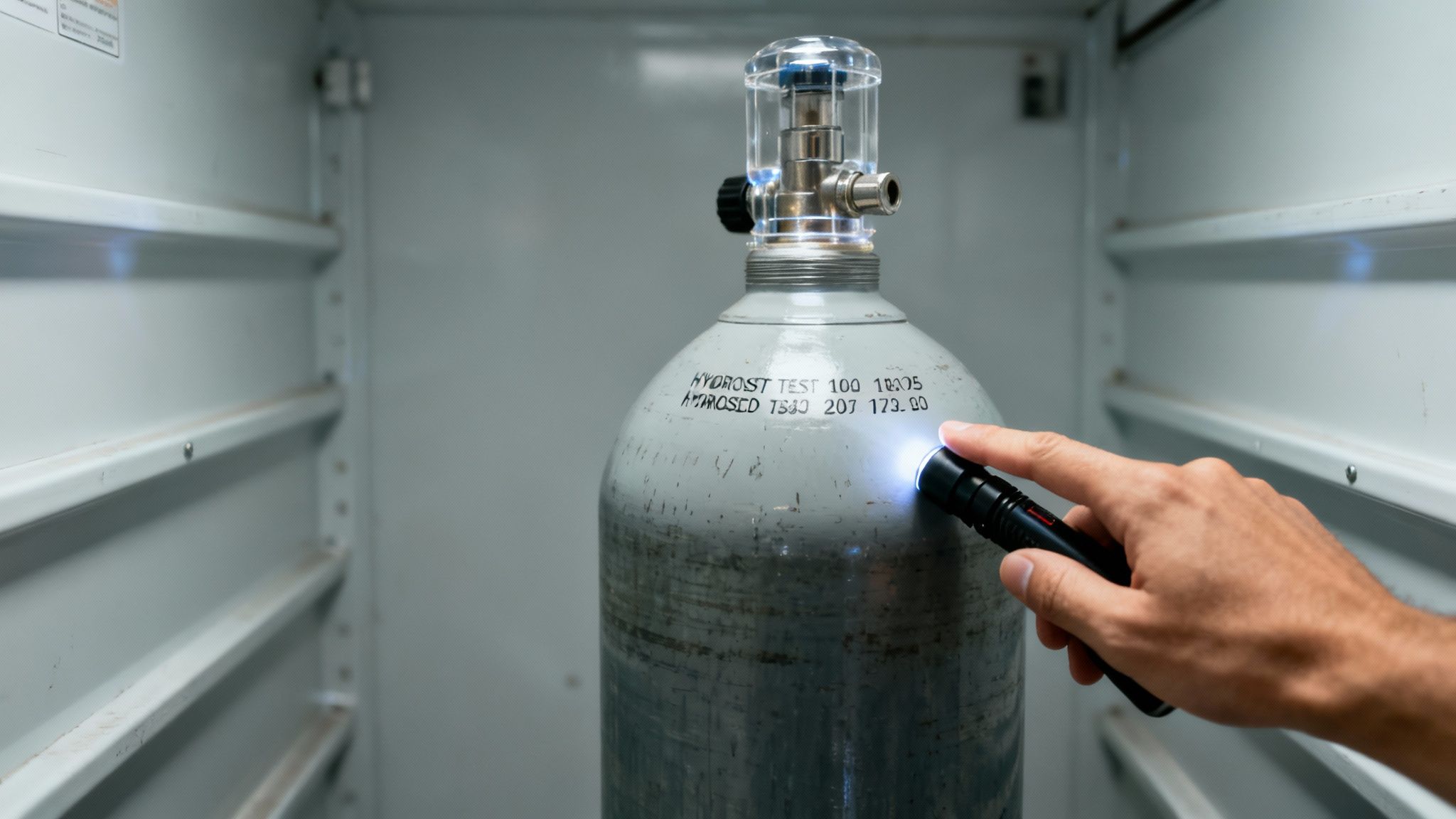
Treating your CO2 cylinder with respect is essential for safety. A few minutes spent on regular checks can prevent a serious accident. Before handling any pressurised canister, it's wise to have a practical risk assessment process in mind. Knowing what to look for makes you a responsible owner.
Your Cylinder Inspection Checklist
Every refillable cylinder has important dates stamped on its neck or shoulder. These numbers tell you if it's still safe to use.
The key date is the hydrostatic test date. In the EU, most CO2 cylinders must be professionally tested every 10 years. This confirms the cylinder can still handle the high pressure. Any professional service will check this date and refuse to fill an expired cylinder.
Before you go for a refill, do a quick visual inspection.
- Check the Test Date: Is the last hydrostatic test date within the last 10 years?
- Look for Damage: Are there any deep dents, gouges, or scrapes on the cylinder body?
- Inspect for Rust: Is there any deep, flaking rust? A little surface rust may be okay.
- Examine the Valve: Does the valve look bent or damaged? Are the threads clean?
- Check for Bulges: Is the cylinder's shape uniform? Any warping is a major red flag.
If you find any of these issues, do not try to get the cylinder refilled. A damaged cylinder is unsafe.
Expert Tip: Use your phone's flashlight to get a clear look at the valve and date stamps. Bright light helps you spot small cracks or worn O-rings.
Proper Storage and Handling
How you store your CO2 cylinder is just as important as its condition. The rules are simple but crucial.
Always keep your cylinder upright in a cool, dry, and well-ventilated area. Keep it away from direct sunlight or heat sources like ovens. Heat causes the internal pressure to rise. Good ventilation helps disperse any minor leaks. This is also important for maintaining good indoor air quality. You can learn more in our Knowledge Hub.
What to Do with a Damaged Cylinder
If your cylinder is damaged or out of date, you must decommission it safely. Never try to repair it yourself.
Contact your local waste management facility or the original supplier. They will have a specific procedure for disposing of pressurised gas containers. These professionals can safely depressurise and recycle the metal.
Disclaimer: Home filtration complements—not replaces—professional advice. Always consult with a qualified expert for specific concerns.
Frequently Asked Questions
When you first look into how to ricaricare bombola co2, some common questions come up. Here are straightforward answers to the most frequent queries.
How much does a CO2 refill cost?
The cost of refilling a CO2 cylinder varies, but it is almost always cheaper than an exchange. For a standard 425g cylinder, you can expect to pay between €10 and €25 at a professional refill station.
Prices depend on local market rates for food-grade CO2 and the shop's location. Larger cylinders, like 2kg models, typically offer a better price per gram.
Can I get any brand of cylinder refilled?
Mostly, yes. As long as you have a standard, refillable cylinder, most professional services can handle it. They are equipped for common valve types and usually don't care about the brand name.
The main exception is proprietary "quick connect" systems on some newer cylinders. Not every shop can handle these. It's best to call first if your cylinder has a unique valve.
Heads Up: This only applies to refillable cylinders. Never attempt to refill a disposable, single-use CO2 cartridge. It is extremely dangerous.
How should I transport a CO2 cylinder safely?
You must secure the cylinder in an upright position in your car. The easiest way is to wedge it in a footwell or place it in a snug box in the boot. This prevents it from tipping over or rolling around.
Never leave a cylinder in a hot car, especially in direct sunlight. Heat causes the internal pressure to build, creating a serious safety hazard.
What should I do if I hear a hissing sound from my cylinder?
First, don't panic. A hissing sound means gas is escaping. If the cylinder is connected to an appliance, the leak might be a bad connection. Try disconnecting it to see if the hissing stops.
If the sound comes directly from the cylinder's valve, move it to a well-ventilated area, preferably outside. Do not try to fix the valve yourself. Call the service where you got it refilled or the supplier for guidance. While addressing the leak, it's a good time to consider your home's overall air quality. Our guide on the benefits of an ozone generator air purifier might be helpful.
At Modern Essentials, we provide clear, practical solutions for a healthier home. Our EU-based team is ready to help. For information about delivery, please see our Shipping Policy.
See the Air Purifiers kit that installs in minutes.