

Brita On Tap: A Practical Guide for Your Kitchen
Thinking about a Brita On Tap filter? This guide is for anyone who wants great-tasting, filtered water straight from their kitchen tap, without any fuss. We will cover how it works, what to check before you buy, and how it compares to other options. We want to give you clear information to help you decide.
Quick Answer: The Brita On Tap is a small filter that attaches directly to your kitchen tap. It uses an activated carbon block to help reduce substances like chlorine and limescale. Each filter lasts for about 600 litres. It offers instant filtered water, making it more convenient than a pitcher.
Understanding the Brita On Tap System
Getting better water at home should be simple. The Brita On Tap is a compact device that clips right onto your kitchen tap. It gives you filtered water whenever you want it. This system is a simple upgrade to improve the taste and quality of your tap water.
This type of filter is useful if you live where tap water has a strong chlorine taste. By filtering water as it comes out, you get cleaner, fresher-tasting water for drinking or cooking. It's much handier than a filter jug you have to keep filling.
What Is a Brita On Tap Filter?
The Brita On Tap is a small filter system you attach to your kitchen tap. Inside, it has an activated carbon block designed to reduce substances like chlorine, some pesticides, and limescale. The result is better-tasting water, on demand.
The biggest benefit is efficiency. There is no waiting like with a filter pitcher. You just flick a switch on the unit for filtered water. It’s perfect for busy families. If you want to dive deeper, check our detailed guide on tap water purifiers.
In this guide, we'll walk you through everything about the Brita On Tap system, including:
- How It Works: We’ll look at the activated carbon and ion exchange technology.
- Installation: A quick checklist to make sure it will fit your tap.
- Performance: What it's designed to filter out.
- Costs: A clear look at the initial price and the filter lifespan.
By the end, you'll understand what this filter can do, making it easier to decide if it’s right for your kitchen.
Home filtration complements—not replaces—professional advice for specific water quality concerns.
How the On Tap Filtration Process Works
So, how does the Brita On Tap clean your water? It’s a multi-stage filtration process packed into a small device. Think of it as a miniature water treatment plant on your tap, working instantly to improve taste, smell, and clarity.
The process starts when you switch to the filtered setting. First, your tap water hits a pre-filter screen. This mesh catches larger bits like sand, rust, or sediment from older plumbing.
From there, the water moves into the heart of the system.
The Power of Activated Carbon
This is where the main work happens. The water flows into a solid block of activated carbon. Picture this as a highly porous sponge with a huge internal surface area.
As water passes through, a process called adsorption occurs. Contaminants are chemically drawn to and stick onto the surface of the carbon. The Brita On Tap uses advanced carbon filters to capture various substances.
This stage is great at reducing chlorine, which often gives tap water a swimming pool smell. It also helps trap certain pesticides and other organic compounds, leaving you with water that tastes crisp and clean.
Tackling Limescale and Hardness
After the carbon treatment, the water meets an ion exchange resin. This part of the filter is designed to deal with water hardness.
Hard water contains dissolved minerals, mostly calcium and magnesium. These minerals are the cause of limescale build-up in your kettle.
The ion exchange resin swaps the "hard" calcium and magnesium ions for "soft" sodium ions. This simple trade softens the water, which helps prevent limescale and can improve the taste of your tea or coffee.
Final Polish and Smart Design
The final part is the practical design. Filtered water flows out, ready to drink, while the unit lets you easily switch between filtered and unfiltered water. You get clean water for drinking and regular tap water for washing up.
This feature helps extend the filter lifespan. You aren’t wasting the filter's capacity on tasks that don’t need purified water. Our guide on drinking water purification explores these technologies further.
By combining a physical barrier, activated carbon, and an ion exchange resin, the Brita On Tap offers a powerful solution for better water.
Checking Tap Compatibility and Installation
One of the best things about the Brita On Tap system is how easy it is to set up. Most people can install it in minutes without tools. Brita includes several adapters in the box, designed to fit most standard kitchen taps in EU homes.
The process is simple. You unscrew the aerator at the end of your tap. Then, you pick the right adapter, screw it on, and click the filter unit into place.
That said, the most important step is checking your tap compatibility before you buy. A quick check now will save you a headache later.
Will It Fit My Tap?
Not all taps are the same. The Brita On Tap is designed for common round taps. It generally won’t work with taps that have a pull-out spray hose or unusual shapes. A good, tight fit is crucial.
To make it easy, here’s a quick checklist.
Brita On Tap Compatibility Checklist
- Is the end of your tap round?
- Does it have a screw-off aerator at the tip?
- Is the nozzle diameter between 13 mm and 25 mm?
- Is it a standard tap (not a pull-out spray type)?
- Is there at least 10 cm of clearance below the tap?
Taking a minute to measure your tap's diameter can save a lot of hassle. If you're looking for a more built-in solution, our guide on under-sink water filters explores other options.
A Look Inside the Filter
Once installed, the filter works instantly. Inside the compact unit, your water goes through several stages of cleaning.
This diagram shows how different layers work together to trap impurities.
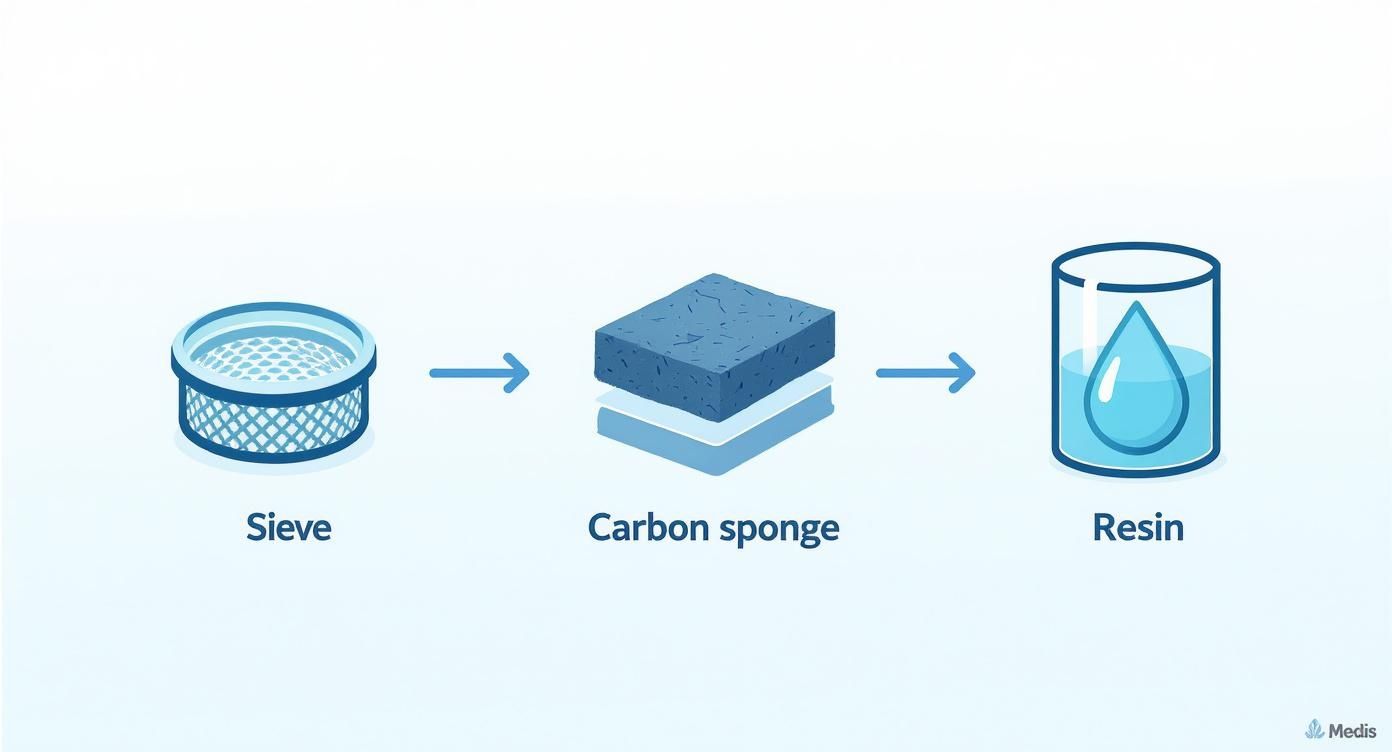
From a simple mesh screen to the activated carbon block, each part has a specific job in making your tap water taste better.
Your Step-by-Step Installation Guide
Ready to get started? Here's a simple breakdown.
- Unscrew Your Aerator: Gently twist off the aerator at the end of your tap. Use a cloth for a better grip if it's tight.
- Find the Right Adapter: The kit comes with a few sizes. Hold them up to your tap's thread and pick the one that screws on smoothly.
- Attach the Adapter: Screw your chosen adapter onto the tap until it's hand-tight. Make sure the rubber washer is flat inside to create a seal.
- Connect the Filter Unit: Line up the filter unit with the adapter and turn the connecting ring to lock it on.
- Flush the New Filter: Before you drink, switch to the filtered setting and let water run for a couple of minutes. This rinses out any harmless carbon dust.
Expert Tip: If you see a small leak, it's usually the wrong adapter or a poorly seated washer. Unscrew the unit, check that the seal is flat, and tighten it again.
And that's it—your new filter is ready to use.
Filter Lifespan, Performance and Costs
The upfront price of a water filter is only part of the story. The true value depends on how long each filter lasts and the ongoing costs. The Brita On Tap system aims for a balance between performance and affordability.
Each standard Brita On Tap cartridge is rated for about 600 litres of water. For an average family, that's around three to four months of use. This longer filter lifespan is a big advantage over water filter jugs, which often need new cartridges monthly.
One great feature is the digital display that counts down from 600 litres. It gives you a clear heads-up when it's time for a new one.
Calculating Your Annual Costs
So, what does it really cost over a year? Let's break it down.
- Initial System Cost (€): The starter kit includes the main filter unit and your first cartridge.
- Annual Refill Cost (€): You’ll likely need 3 or 4 new cartridges a year. Buying them in multi-packs can save money. Check sizes & refills — fast EU shipping.
When you compare these costs to buying bottled water, the savings are clear. Filtered tap water costs just a few cents per litre. Bottled water is much more expensive and creates single-use plastic waste.
What Affects Filter Performance?
While the 600-litre estimate is a good guide, the actual lifespan of your filter can vary based on your local water quality.
If you live in an area with hard water, high in limescale and other sediments, your filter works harder. You might notice the flow rate slowing as the filter captures particles. The activated carbon block is effective, but a heavy load can fill it up faster.
A little maintenance helps. It's a good idea to know how to flush Brita filters properly, especially when you install a new cartridge. This quick step helps ensure a steady flow and good filtration from the start.
Ultimately, the Brita On Tap system offers a practical mix of performance, convenience, and value.
Comparing Brita On Tap with Other Water Filters
The Brita On Tap is a great solution for many, but it's just one type of home water filter. The right system depends on your habits, kitchen layout, and budget. Let's see how it compares to other common options.
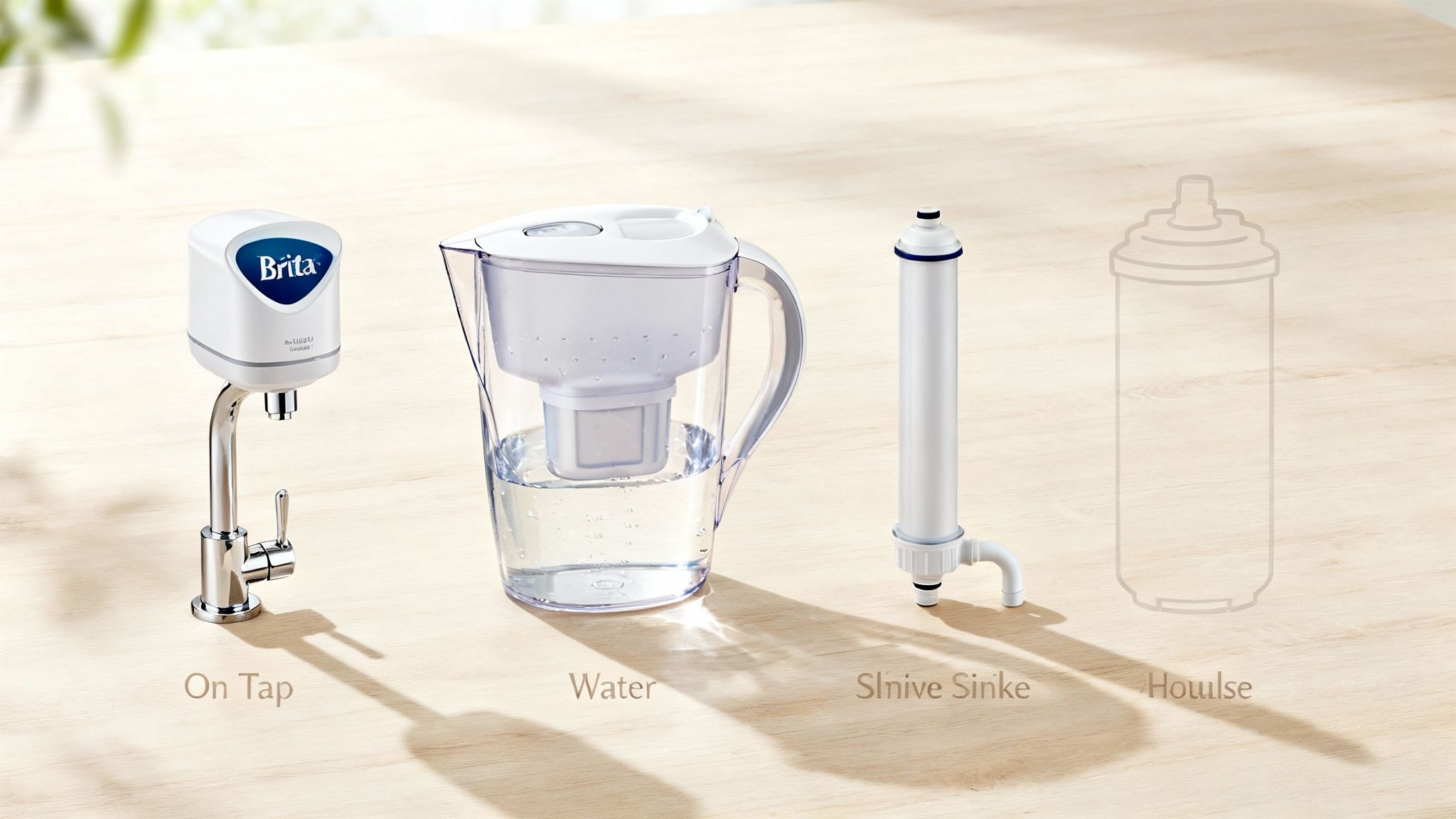
Every filter type strikes a different balance between convenience, cost, and filtering power. A tap filter gives you water on demand, a pitcher offers portability, and an under-sink system works out of sight.
Pitchers, Taps, and Under-Sink Systems
Most people choose between a tap-mounted filter, a filter pitcher, or an under-sink system. The Brita On Tap sits in the first category, offering a great middle-ground. It’s more convenient than refilling a pitcher but less complex to install than an under-sink unit.
Filter pitchers are simple to start with. There’s no installation, and the initial cost is low. The downside? You have to wait for them to filter, they need constant refilling, and their small capacity can be frustrating.
Under-sink systems are the heavy-duty option. Tucked away under your cabinet, they filter a large volume of water with a fast flow rate. The trade-off is a higher price tag and more complex installation. Our guide on choosing a water filter pitcher has more detail on that option.
Side-by-Side Comparison
This table gives you a quick snapshot of what to expect from each system. Compare options with our quick table.
Home Water Filter Comparison
| Feature | Brita On Tap System | Filter Pitcher | Under-Sink System |
|---|---|---|---|
| Installation | DIY, minutes, no tools | No installation needed | Professional or advanced DIY |
| Convenience | Instant filtered water | Requires refilling and waiting | Instant, high flow rate |
| Filter Lifespan | ~600 litres / 3-4 months | ~150 litres / 1-2 months | ~2,000-5,000 litres / 6-12 months |
| Initial Cost | Low to moderate (€) | Low (€) | High (€€€) |
| Long-Term Cost | Moderate cartridge cost | High cartridge cost per litre | Lower cost per litre |
| Kitchen Space | Small unit on tap | Takes up fridge/counter space | Hidden under the sink |
Key Takeaway: The Brita On Tap shines in convenience and ease of use. It delivers filtered water instantly without cluttering your counter. It hits a sweet spot between the low entry cost of a pitcher and the on-demand performance of an under-sink system.
Troubleshooting Common On Tap Issues
Even a reliable device like the Brita On Tap can have occasional issues. The good news is that most problems are simple to fix yourself. We'll walk you through the steps to get your filter running smoothly again.
A few quick checks can solve most problems in minutes.
Dealing With Leaks Around the Tap
A leak is the most common issue after installation, but it’s usually an easy fix. A watertight seal is essential.
If you see water dripping where the filter meets your tap, it's usually one of two things: the wrong adapter or a poorly seated rubber washer.
- Check the Adapter: Unscrew the unit. Make sure you’ve picked the best-fitting adapter from the pack.
- Inspect the Washer: Check the small black rubber washer inside the adapter. It must be lying completely flat.
- Tighten Securely: Reattach the unit and tighten it by hand until it’s snug. Avoid using tools, which can damage the plastic threads.
Fixing a Slow Flow Rate
Has your stream of filtered water slowed to a trickle? A weak flow rate is usually caused by trapped air in a new cartridge or high sediment in your water.
When you install a new filter, air bubbles can get stuck in the activated carbon block. Let the water run for a few minutes to flush the air out.
If the flow rate slows down over time, it's a sign the filter is working. It has trapped a lot of sediment and particles like limescale, which are starting to clog its pores. This is a clear signal that it's time for a replacement.
Resetting a Faulty Indicator
The digital display is a great feature, but it can sometimes be stubborn. If the indicator doesn't reset to 600 litres after a cartridge change, a manual reset should work.
You'll usually find a small reset button near the display. With the new cartridge in place, press and hold that button for a few seconds. The screen should flash and then show the full capacity.
Simple Cleaning and Maintenance
To keep your Brita On Tap working well, clean it occasionally. Grime and limescale can build up on the outside.
Wipe the housing down with a soft, damp cloth and mild washing-up liquid. Avoid harsh cleaners. Remove the filter cartridge before you start cleaning, then pop it back in when you're done.
Frequently Asked Questions
Here are answers to common questions about the Brita On Tap system.
Does the Brita On Tap Remove All Contaminants?
The Brita On Tap is designed to improve the taste and smell of your tap water. Its activated carbon block helps reduce substances like chlorine, certain pesticides, and lead.
However, it is a reduction filter, not a full purifier. It is not designed to tackle viruses or bacteria. It takes safe tap water and makes it taste better.
Can I Use Hot Water with the Filter?
No. You should only run cold water through the filter. The filter media inside cannot handle heat.
Running hot water through the unit can damage the materials, making the filter less effective and shortening its lifespan. When you need hot water, use the bypass switch. This saves your filter's capacity for cold water.
How Do I Know When to Change the Cartridge?
The system has a digital indicator that counts down from 600 litres. It gives you a clear visual of how much filtering capacity is left.
When the counter hits zero, it's time for a new one. For most families, this is about every three to four months. You can find replacement filters and cartridges on our site.
Is the Brita On Tap Environmentally Friendly?
Yes. Compared to buying single-use plastic bottles, the Brita On Tap is a much better choice for the environment. A single filter cartridge can replace up to 600 one-litre plastic bottles. This means a huge reduction in household waste.
While you do replace the cartridges, you still cut down on the environmental impact tied to producing and shipping bottled water. Curious about how we ship? Check out our Shipping Policy.
Ready to enjoy crisp, clean water straight from your tap? At Modern Essentials, we offer simple Water Filters for modern living.
See the tap filter kit that installs in minutes.