

Filtri Sottolavello per Acqua: Your Practical Guide to Better Water
Tired of tap water that tastes of chlorine or leaves chalky limescale on your kettle? It’s a common problem, but the solution is simple and hides neatly out of sight. An under-sink water filter, or filtro sottolavello per acqua, is an easy upgrade that can completely transform the water in your kitchen.
Quick Answer: An under-sink water filter connects to your cold water line to improve taste and quality. It uses an activated carbon cartridge to help reduce common contaminants like chlorine, sediment, and some chemicals. The result is better-tasting water for drinking and cooking, straight from your existing tap.
Why Do I Need an Under-Sink Water Filter?
An under-sink water filter is one of the most practical additions to a modern home. Forget bulky filter jugs that are never full when you need them. A filtro sottolavello per acqua is tucked away, quietly delivering clean, fresh water right from your tap. It's about convenience—better-tasting drinks, cleaner water for cooking, and zero fuss. See the Water Filters kit that installs in minutes.
The main purpose is to capture common water issues at the source. While your tap water is safe, it is often treated with disinfectants like chlorine that can give it an unpleasant taste and smell. On its way to your home, water can also pick up sediment and other particles.
The Benefits of an Under-Sink System
Installing a filter under your sink brings immediate perks you will notice every day. It's a small change with a surprisingly big impact.
- Improved Taste and Odour: This is the first thing everyone notices. The system is designed to capture that chemical, chlorine-like taste, making your water refreshing to drink.
- Better Coffee and Tea: When you start with clean water, the real flavours of your coffee beans and tea leaves can shine through without any off-tastes.
- Appliance Protection: By helping reduce limescale and sediment build-up, these filters can help your coffee machine, kettle, and other appliances last longer.
- Cost-Effective and Convenient: It is much cheaper than buying endless plastic bottles of water, and you’ll never have to carry them home from the shop again.
Beyond Drinking Water
But it's not just about a better glass of water. High-quality filtered water elevates everything you do in the kitchen. For example, learning about the precise role water plays in coffee flavor makes it clear that a great brew starts with great water.
Many people start with a filter jug but quickly discover its limits. If you're weighing your options, our guide on the differences between under-sink systems and water filter jugs in our Knowledge Hub explains why a dedicated system is often the smarter long-term choice. You get a constant, steady flow of filtered water without cluttering your worktops.
How Under-Sink Water Filters Work
Ever wondered what’s happening inside that canister tucked away under your sink? The way an under-sink water filter works is quite simple and effective.
Think of it as a gatekeeper for your kitchen tap. Before the cold water reaches your glass, it is rerouted through a special filter cartridge. This is a highly engineered system designed to capture tiny impurities you cannot see but can definitely taste and smell.
The whole process happens instantly. Water flows from your pipe, gets pushed through the filter, and comes out of the tap cleaner, fresher, and better-tasting. It’s a silent, invisible upgrade to your kitchen.
The Real Hero: Activated Carbon
The secret ingredient in most quality under-sink filters is activated carbon. This is a special type of carbon that has been treated to become incredibly porous, creating a massive surface area in a tiny space.
Picture activated carbon as a type of chemical magnet. As water flows over it, a process called adsorption occurs. Unpleasant substances like chlorine, pesticides, and other volatile organic compounds (VOCs) that cause bad tastes and smells get stuck to the carbon's surface. This is what finally helps reduce that faint "swimming pool" odour in your tap water.
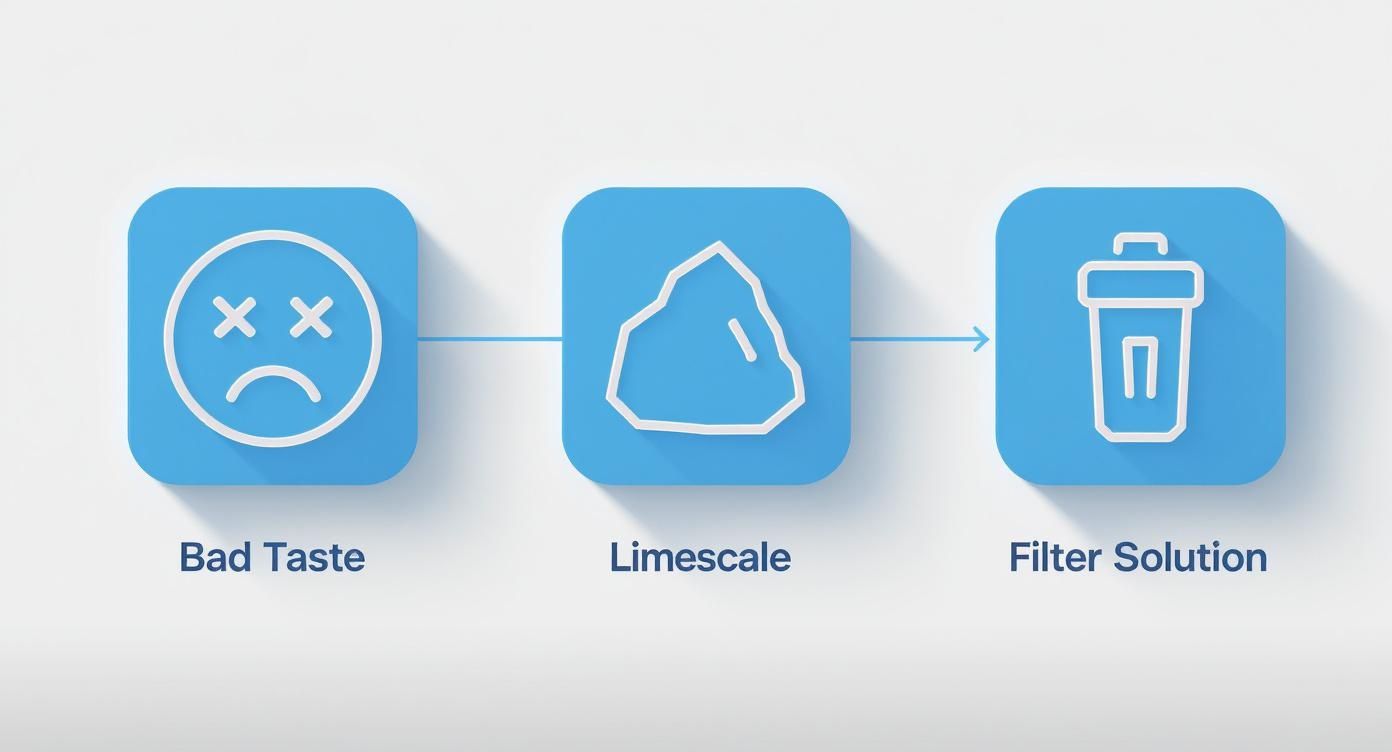
This simple illustration shows how an out-of-sight filter can tackle everyday water problems, like funny tastes or limescale build-up.
Layer by Layer: How Multi-Stage Filtration Works
For even better results, many modern filters use a multi-stage approach. It’s like having a team of specialists, each one tackling a different problem to make sure nothing slips through.
A typical system often includes these layers:
- Sediment Pre-Filter: This first stage is all about catching larger particles—rust, sand, silt, and other debris. It stops these particles from clogging up the more sensitive filters that come next.
- Activated Carbon Block: This is where the heavy lifting happens. A solid block of activated carbon gets to work adsorbing chlorine, chemicals, and anything that makes your water taste or smell off.
- Polishing Filter: Some systems add one last step to "polish" the water, ensuring it has a crisp, pure, and refreshing taste right out of the tap.
This approach is designed to target the bad stuff while leaving the good stuff in. Healthy, naturally-occurring minerals like calcium and magnesium are left untouched.
Making Sense of Technical Terms
When shopping, you will see terms like "flow rate" and "filter lifespan." They sound technical, but they just tell you how the filter will perform in your home.
Flow rate is how fast the filtered water comes out of your tap, measured in litres per minute (LPM). A good flow rate means you won’t wait forever to fill a pot of water—it should feel just like your normal tap.
Filter lifespan tells you how long the cartridge will last before it needs changing, usually in months or total litres. Following the replacement schedule is important. An old, clogged filter will not work effectively.
While activated carbon is brilliant for everyday improvements, some people want a more powerful solution. If you're curious about other technologies, you can dive deeper in our guide on reverse osmosis systems.
Paying attention to these two specs will help you find a system that delivers great-tasting water consistently.
Choosing the Right Filtri Sottolavello per Acqua
With so many models available, picking the right under-sink filter can feel overwhelming. But it doesn’t have to be. Let’s break it down into simple steps to help you find the perfect match for your kitchen, whether you want to get rid of the chlorine taste or battle stubborn limescale.
The goal is to find a system that gives you cleaner water and also fits your budget, lifestyle, and the space under your sink. By looking at the most common types of filtri sottolavello per acqua side-by-side, you can make a confident choice.
First, What’s in Your Water?
Before you start looking at filters, think about what you want to change about your tap water. Is the taste just a bit "off" because of chlorine? Or are you worried about sediment? Different filters are designed to tackle different problems.
- For Better Taste and Smell: If your main goal is fresher water for drinking and cooking, a standard activated carbon filter is a great, budget-friendly option. It’s excellent at capturing chlorine.
- For All-Round Improvement: If you're concerned about a wider range of things like sediment, certain chemicals, and limescale, a multi-stage filter is a good choice. These systems use several filtration layers to tackle multiple issues at once.
- For Ultimate Purity: For anyone wanting the highest level of purification, a reverse osmosis (RO) system is the most powerful choice. Just know that they are more complex, take up more space, and usually have a higher price tag.
If you’d like to learn more about how these purification methods work, our guide on various drinking water purification techniques is a great place to start.
Comparing Under-Sink Water Filter Options
To help you decide, let's compare the most common under-sink filter types. This quick table highlights their strengths and what to consider, making it easier to see which one fits your needs.
| Feature | Standard Activated Carbon Filter | Multi-Stage Filter | Reverse Osmosis (RO) System |
|---|---|---|---|
| Primary Use | Improving taste and odour | Broader contaminant reduction | Maximum purification, removing nearly all impurities |
| Designed to Reduce | Chlorine, odours, some VOCs | Chlorine, sediment, some chemicals, limescale | Up to 99% of all contaminants, including minerals |
| Typical Lifespan | 3–6 months | 6–12 months | 12–24 months (membranes last longer) |
| Installation | Very simple, often DIY | Simple, usually DIY | More complex, may need professional help |
| Maintenance Cost | Low (€) | Moderate (€€) | High (€€€) |
| Best For | Households wanting better-tasting water on a budget | Families seeking an all-round improvement without the complexity of RO | Anyone wanting the purest possible water, regardless of cost/space |
A simple carbon filter is often enough for most homes, but a multi-stage system offers extra peace of mind. Compare options with our quick table.
Practical Things to Check
Once you've narrowed down the type of filter, there are a couple of real-world details to check before you buy.
The Italian water purifier market, valued at around €645 million, is expected to grow to €890 million by 2032. This shows a real shift towards wanting reliable, high-quality water right from the tap. You can read more in the Data Bridge Market Research report on the Italian market.
Space Under Your Sink Get out the tape measure. Before you buy, measure the space you have available. Most single-cartridge filters are compact, but multi-stage or RO systems are much bulkier and need extra room.
Filter Lifespan and Refill Costs Don't just look at the initial price—think about the running costs. The filter lifespan and the price of replacement cartridges are huge factors. A system with affordable, easy-to-find refills will save you money. Check sizes & refills — fast EU shipping is available on all our cartridges.
By thinking about performance and these practical details, you can find the perfect filtro sottolavello per acqua for your home.
How to Install Your Under-Sink Filter
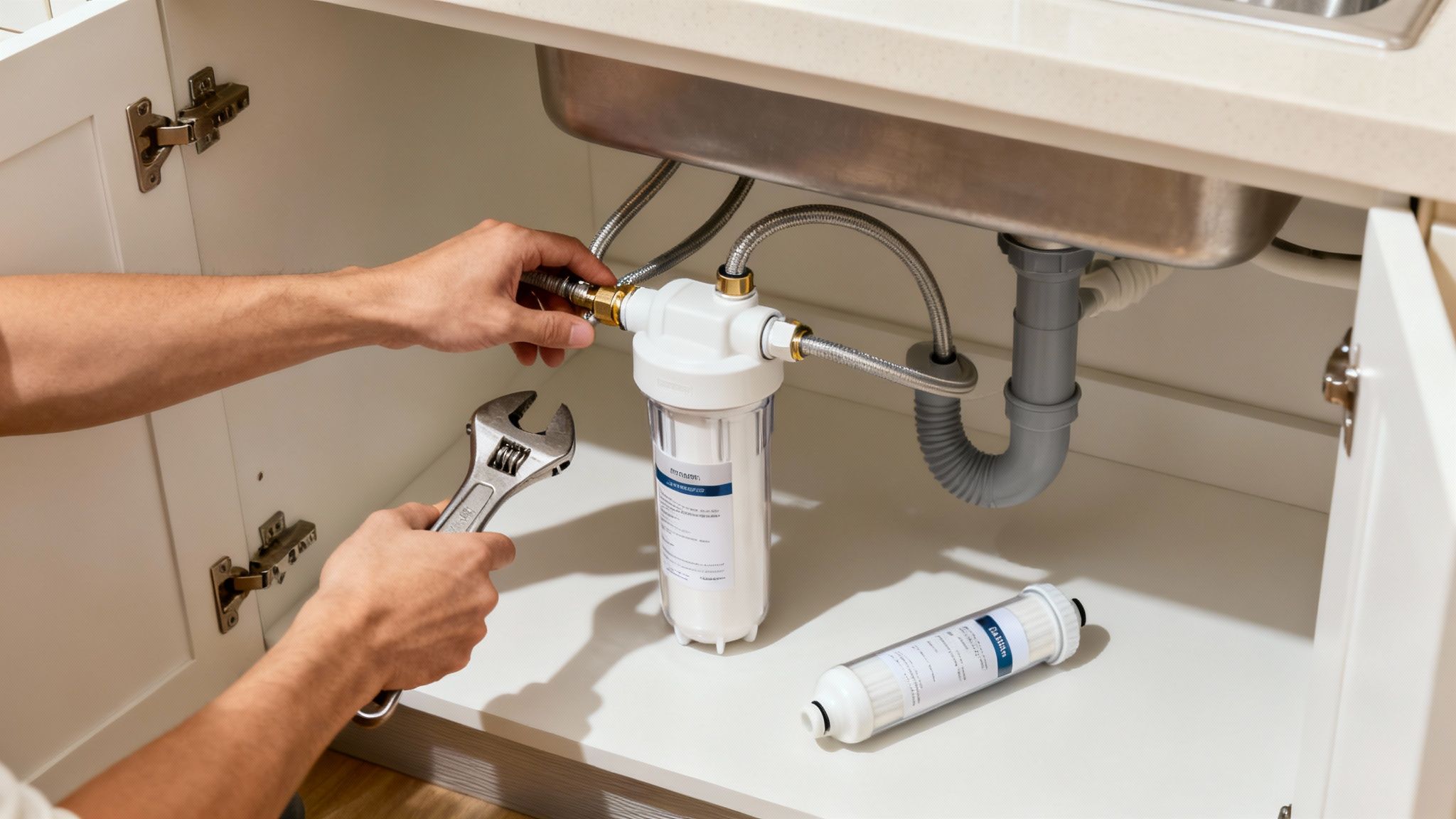
The idea of doing any plumbing can feel intimidating. But most modern filtri sottolavello per acqua are designed so anyone can install them.
You do not need to be a professional plumber. All it takes is a bit of confidence and about an hour of your time. This guide will walk you through everything, step by step.
Your Pre-Installation Checklist
A little preparation goes a long way. Before you unscrew a single pipe, take a few minutes to get organised. This will make the process much smoother.
Ready to start? Let’s run through a quick checklist.
| Checklist Item | Details and Tips |
|---|---|
| Check Your Space | Grab a tape measure. Make sure the filter unit will fit in your cabinet, leaving enough room to connect the hoses without kinking them. |
| Locate Water Shut-Off | Find the small valve on the cold water pipe under your sink. Give it a gentle turn to make sure it’s not seized up. |
| Gather Your Tools | You won't need much: an adjustable wrench, a bucket or an old towel for drips, and possibly a drill if you’re adding a separate tap. |
| Read the Instructions | Every filter kit is a little different. A quick five-minute scan of the manufacturer's guide can prevent a lot of guesswork. |
| Clear the Area | Pull everything out from under the sink. A clear, empty space gives you the freedom to move and see what you're doing. |
Once you’ve ticked off these boxes, you’re ready to start the installation.
The Step-by-Step Installation Process
With your tools handy and the cabinet clear, you're all set. Follow these steps and take your time.
-
Turn Off the Water: This is the most important step. Find the cold water shut-off valve under the sink and turn it clockwise until it stops. Then, open your kitchen tap to let out any water left in the pipe.
-
Disconnect the Cold Water Line: Place a bucket or towel under the pipes. Use your wrench to carefully loosen and disconnect the flexible hose that runs from the valve to your main tap.
-
Install the T-Valve Adapter: Your kit comes with a piece called a T-valve. Screw this directly onto the main shut-off valve. This will divert some of the water to your new filter.
-
Connect the Hoses: Re-attach the tap's original cold water hose to one outlet of the T-valve. Take the new tubing from your filter kit and connect it to the other outlet. The other end of this tube will plug into the "inlet" port on the filter housing.
-
Mount the Filter Housing: Find a good spot on the cabinet wall for the filter unit. You’ll want it somewhere you can easily reach to change the cartridge. Use the included screws to mount it securely.
-
Connect the Outlet and Flush: Take the final piece of tubing and attach it to the "outlet" port on the filter. Put the other end of this tube into your bucket. Slowly turn the water back on at the shut-off valve. Let water run through the filter into the bucket for 5–10 minutes to flush out any harmless carbon dust.
-
Final Connection and Leak Check: Turn the water off one last time. Connect the outlet tube to your main tap's cold water line. Turn the water back on and carefully inspect every connection for drips. If you see one, a gentle extra quarter-turn with the wrench is usually enough.
For systems with a separate filtered water tap, you may need to drill a hole in your worktop. It's important to choose the right drill bits for precise holes to get a clean finish. You can explore different tap types in our complete guide to water purifier taps.
Maintaining Your Filter for Peak Performance
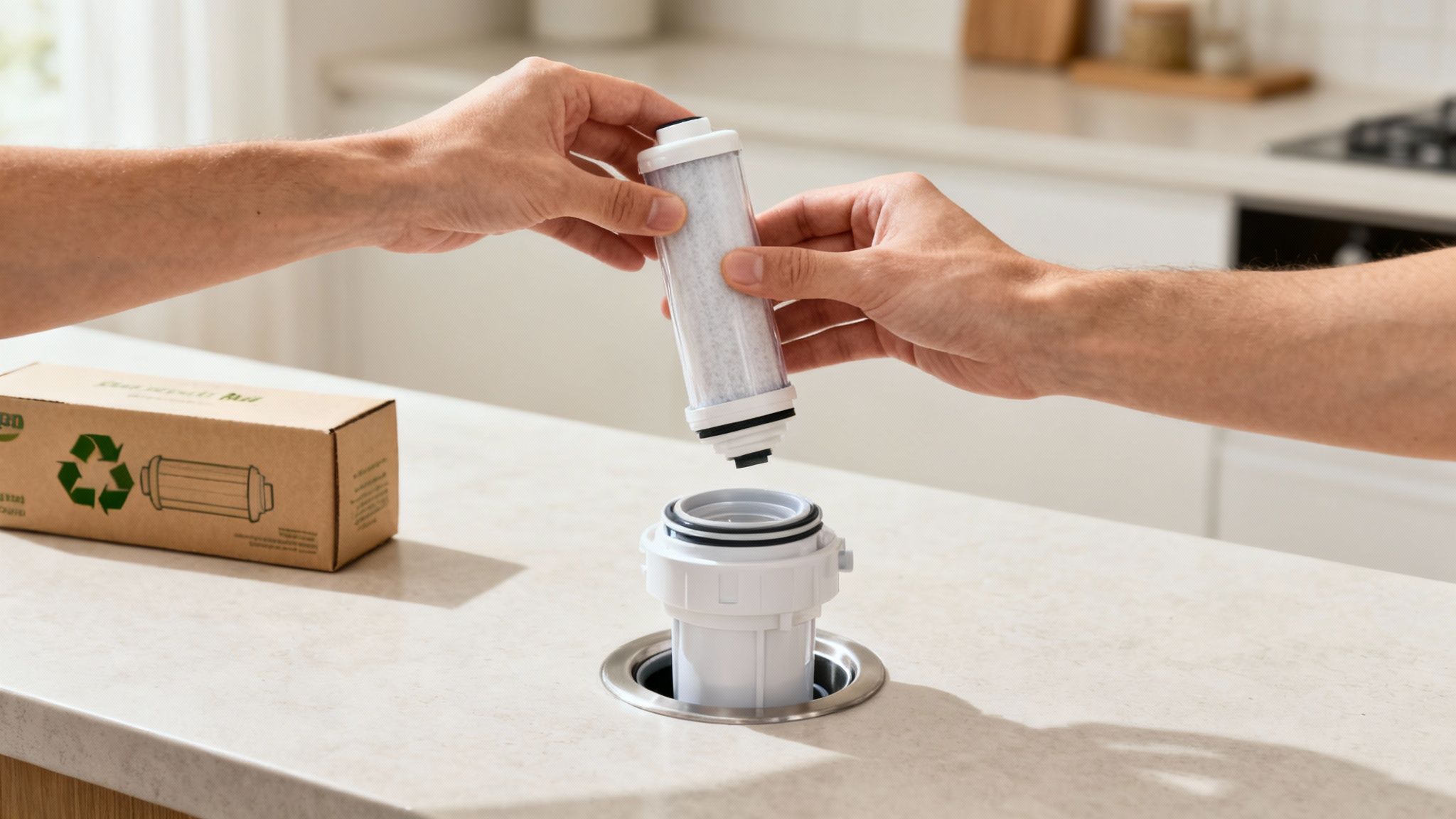
Your under-sink water filter is a quiet workhorse, but it is not a "set it and forget it" appliance. It needs a little attention to keep running smoothly.
Thankfully, maintenance is straightforward and only takes a few minutes every few months. A simple routine is all it takes to guarantee a constant supply of fresh, clean water.
Why Changing Your Filter Cartridge Is Important
The most important thing you can do to maintain your filtri sottolavello per acqua is to replace the cartridge on schedule. This is vital for the filter's performance and your water's quality.
Over time, the activated carbon inside gets loaded with contaminants. Once it hits capacity, it cannot trap new impurities like chlorine effectively.
An old, saturated filter may also become a place where bacteria can grow. Swapping it out regularly ensures your water stays pure and the system keeps doing its job.
How to Know When It’s Time for a Change
Most filter manufacturers give a clear filter lifespan, typically between three to six months. But it's good to know the signs that a change is due.
- Slower Water Flow: If you notice your tap’s flow rate has dropped, that's a classic sign the filter is clogged with sediment.
- Return of Old Tastes and Odours: The moment you notice that hint of chlorine again, you can be sure the activated carbon is maxed out.
Think of your filter cartridge like a kitchen sponge. It can only absorb so much before it’s full. Sticking to the recommended replacement schedule is the simplest way to get consistently great-tasting water.
Costs and Environmental Impact
One of the biggest benefits of under-sink filters is their low running cost, especially compared to bottled water.
Annual costs are just the price of replacement cartridges. For a typical system, you’re looking at around €30 to €60 per year for refills. That small investment gets you thousands of litres of purified water. You can check sizes & refills — fast EU shipping is available for all our replacement cartridges.
The Italian market for under-sink filters continues to show strong interest. While growth has adjusted slightly, demand remains solid as people invest in better water quality. You can dive deeper into these trends in the Italian water purifier market from 6Wresearch.
To reduce your environmental footprint, look for brands that offer recyclable cartridges. Many modern systems are designed with sustainability in mind. Our Refills & Cartridges collection shows you options designed for responsible disposal.
Common Questions About Under-Sink Water Filters
Let's wrap up by answering some common questions about under-sink water filters. Getting straight answers to these practical concerns helps you feel confident in your choice. Disclaimer: Home filtration complements—not replaces—professional advice.
Will an Under-Sink Filter Reduce My Water Pressure?
No, not really. Modern filtri sottolavello per acqua are designed to have a minimal effect on your water pressure. You should not notice any difference in the flow rate when filling a glass.
If you ever see a big drop in pressure, it's the number one sign that the filter is clogged. A simple cartridge swap will get the flow back to normal.
Can I Install a Filter on Any Kitchen Tap?
Yes, you can. These systems are versatile. Most kits connect to the standard cold water lines found in modern EU kitchens.
They attach to the pipe, not the tap itself. This means you can keep your existing kitchen tap. The only reason to change it would be if you wanted a separate faucet just for filtered water.
Do These Filters Remove Healthy Minerals?
No, and this is one of the best things about standard activated carbon filters. They are selective. They are designed to capture things like chlorine and sediment while letting beneficial minerals like calcium and magnesium flow through.
This sets them apart from systems like reverse osmosis, which can strip water of almost everything. With a quality under-sink filter, you get cleaner, tastier water that still has its natural goodness.
Is Filtered Tap Water Better Than Bottled Water?
Yes. Filtered tap water wins from both a practical and environmental view. It gives you incredible convenience—great-tasting water on demand—while reducing your household's use of single-use plastic. It's a limitless supply for a fraction of what you'd spend on bottled water.
Plus, you avoid the large environmental footprint that comes with making and shipping plastic bottles. It's a small change that makes a big difference. If you're curious about local water quality, check out our guide on the safety of tap water in Italy.
At Modern Essentials, we believe everyone deserves better water without the fuss. Our systems are built for easy installation and reliable filtration. See the Water Filters kit that installs in minutes.